9709 Integration (Pure 1): Notes & Worked Solutions
- Integration
- 9709 Integration is the reverse of differentiation. If differentiating a function gives you the gradient, integrating brings you back to the original function. In exam terms, it answers two types of questions: find the expression and find the area. Topics 1.8.1–1.8.5 of the Cambridge International AS & A Level Mathematics 9709 (Pure 1) syllabus cover basic powers, the reverse chain rule, definite integrals, areas under curves, and volumes of revolution. 9709 Integration questions typically carry 15–20 marks out of 75 on Paper 1.
ExamPilot maps your weak 9709 topics and drills them until they're not. Built for Cambridge 9709.
Practise integration with adaptive questions calibrated to your level
Free during beta. No card needed.
We'll never share your email.
By joining, you agree to receive emails from ExamPilot. Unsubscribe any time.
Key takeaways
- Cambridge 9709 Paper 1 integration tests indefinite integrals, definite integrals, and areas enclosed between curves and the x-axis.
- Integrating expressions of the form (ax + b)ⁿ — where you divide by the new power and also by a — appears consistently across Paper 1 sessions and is worth mastering as a reliable source of marks.
- The most common integration error in 9709 is omitting the constant of integration (+C) in indefinite integrals — a single-mark loss that accumulates fast.
- ExamPilot identifies exactly which integration techniques you're dropping marks on and targets adaptive practice at those gaps until they close.
This guide is part of our Cambridge 9709 Pure 1 — your comprehensive resource for exam preparation.
Integration is where 9709 Paper 1 separates the A* students from the rest — most resources give you the rules and leave you to figure out exam technique from past papers alone. This guide covers every technique in Topics 1.8.1–1.8.5 of the Cambridge 9709 syllabus, the exam traps, and the checks that actually earn marks. Already covered 9709 Differentiation? You have a head start — integration is differentiation in reverse.
What 9709 Integration Covers in Pure 1
9709 Integration is the reverse of differentiation. If differentiating a function gives you the gradient, integrating brings you back to the original function. In exam terms, it answers two types of questions: find the expression and find the area.
What's in scope for Paper 1
The Cambridge 9709 integration syllabus for Pure 1 covers these integration techniques a level students need to master:
- Integration as the reverse of differentiation
- Integration of (ax + b)ⁿ for any rational n (except n = −1) (including constant multiples, sums and differences)
- Evaluating definite integrals
- Finding the area of a region bounded by a curve and lines
- Finding volumes of revolution about the x-axis (about one of the axes, including regions not bounded by the axis)
What's not in Pure 1: integration by parts, integration by substitution (the formal method), partial fractions, or trigonometric integrals. Those are Pure 3. For the trigonometry foundations, see our Pure 1 9709 Trigonometry.
How many marks is it worth?
Integration questions typically carry 15–20 marks out of 75 on Paper 1. That's 20–27% of the paper from one topic. When you add in questions that combine integration with differentiation or coordinate geometry, calculus as a whole accounts for 35-40% of Paper 1 marks.
Core 9709 Integration Skills You Need for Paper 1
The fundamental rule reverses the power rule for differentiation: add one to the power, divide by the new power, and add the constant of integration.
Before integrating, convert roots and fractions into power notation. You must rewrite √x as x½ before applying the power rule. The same applies to 1/x², which becomes x⁻².
When the expression inside the brackets is linear (of the form ax + b), you can integrate directly by adjusting for the coefficient of x. The key is the extra division by a — the coefficient of x inside the brackets. This compensates for what the chain rule would produce if you differentiated the result.
A definite integral has limits — an upper value and a lower value. You evaluate the integrated expression at both limits and subtract. No +C needed for definite integrals — the constant cancels when you subtract.
Understanding areas visually
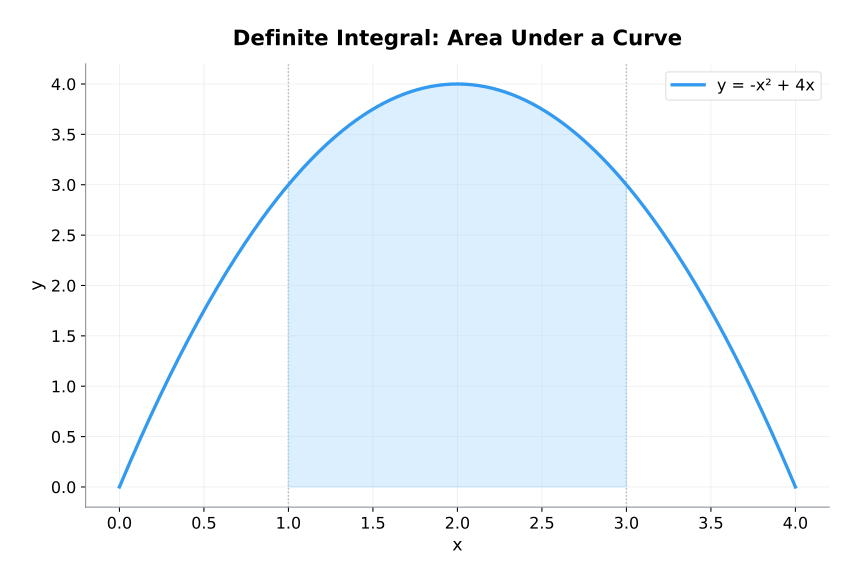
Finding the area under a curve is where integration becomes visual. The area between a curve y = f(x), the x-axis, and two vertical lines x = a and x = b is given by the definite integral.
Area between a curve and a line
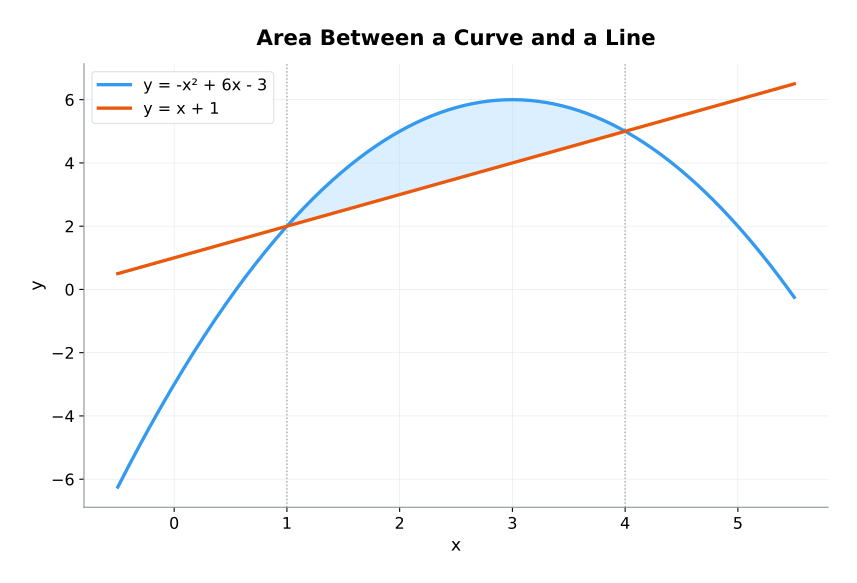
This is the most common 9709 integration question format in Paper 1. The setup matters more than the integration itself: sketch the curve and the line, find the intersection points to get your limits, identify which function is on top, then subtract the lower from the upper and integrate.
How Differentiation and Integration Connect
If you've already covered differentiation, you have a head start. Integration is differentiation in reverse — and understanding that connection is half the battle. The single most powerful exam technique for 9709 integration is to differentiate your answer to check it. If you get back to the original expression, your integration is correct.
What to Do Next
9709 integration is a marks goldmine on 9709 Paper 1 — if you avoid the common traps. You now have the rules, the decision framework, the examiner insights, and the practice questions. Integration builds directly on functions — if you need to revisit domain restrictions, composite functions, or inverse notation first, see our 9709 Functions. The next step is consistent, targeted practice.
Start with the sub-topic you find hardest. If the reverse chain rule trips you up, do 10 questions on it before moving on. If area questions confuse you, practise the setup — sketching and finding intersection points — before worrying about the integration itself.
ExamPilot's adaptive practice identifies exactly which integration sub-skills you need to work on. Instead of grinding through random questions, you practice the ones that target your specific gaps.
Ready to tackle the other half of calculus? Read our 9709 Differentiation next.
Key formulas
Power Rule for Integration
Add one to the power, divide by the new power, and add the constant of integration. Before integrating, convert roots and fractions into power notation. You cannot integrate √x directly — rewrite it as x½ first.
Reverse Chain Rule
This method ONLY works when the expression inside the brackets is linear (ax + b). If you see (x² + 1)³, you cannot use the reverse chain rule directly — you would need to expand or use a Pure 3 technique. In Pure 1, every integration question involving brackets will use a linear expression.
Definite Integrals
Area Between Curves
Worked examples
Basic integration
Rewriting before integrating
Reverse chain rule
Definite integral with reverse chain rule
Negative power integration
Area between curve and line
Area below the x-axis (the trap)
Common mistakes
Forgetting +C on indefinite integrals
The constant of integration is worth one mark. On a 4-mark question, that's 25% of the marks gone for six characters. Every indefinite integral needs +C. No exceptions. Cambridge examiner reports consistently highlight that candidates who omit +C lose marks they could easily have kept.
Sign errors when integrating negative powers — e.g., integrating 3/x² and missing the negative sign
When you rewrite 3/x² as 3x⁻², the integration gives 3x⁻¹/(−1) = −3x⁻¹ = −3/x. The negative sign trips students up because it appears as part of the rule, not from the original expression. Always write out the power notation step separately. Don’t try to jump from the fraction to the answer in one step.
Not splitting integrals when the area crosses the x-axis
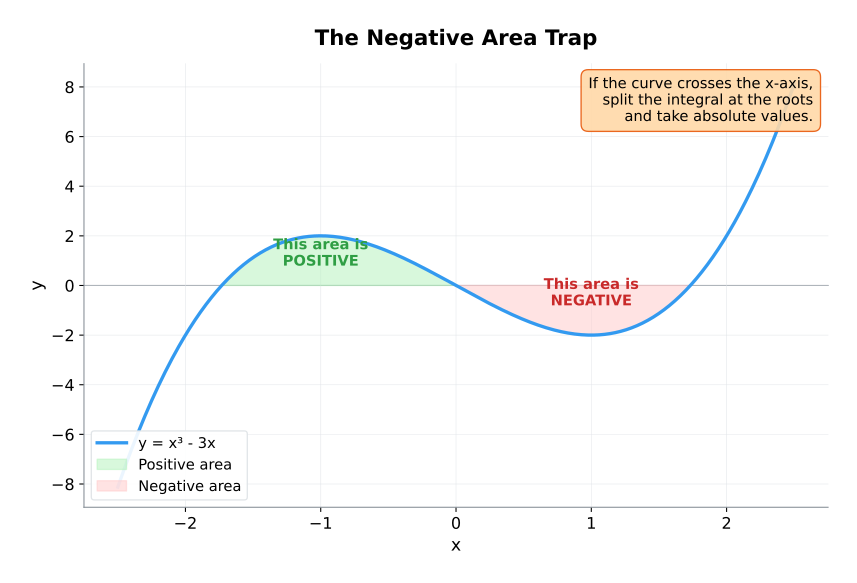
If the question asks for the total area and the curve goes below the x-axis in part of the interval, you must split the integral. A single integral from a to b will give you the net area (positive minus negative), not the total area. Before integrating an area question, check whether the curve crosses the x-axis in the given interval. Set y = 0 and solve.
Using the reverse chain rule on non-linear expressions like (x² + 1)³
The reverse chain rule only works when the expression inside the brackets is linear (ax + b). If the bracket contains a quadratic or anything non-linear, you must expand or use a different approach. In Pure 1, every bracket integration will be linear — but check before applying the rule.
Not showing working on definite integrals — writing only the final number from a calculator
Examiners need to see the integration step, the substitution of limits, and the subtraction. Cambridge examiner reports highlight that showing only a final numerical answer for definite integrals, without the integrated expression or limit substitution, means method marks cannot be awarded — even if the answer is correct. Always write: integrate → show the expression in square brackets with limits → substitute upper limit → substitute lower limit → subtract → simplify.
Exam tips
Which 9709 Integration Method Should You Use?
This is the question students ask most about 9709 integration: how do I know which method to use? For 9709 Pure 1, the decision is simpler than you think — there are only three paths.
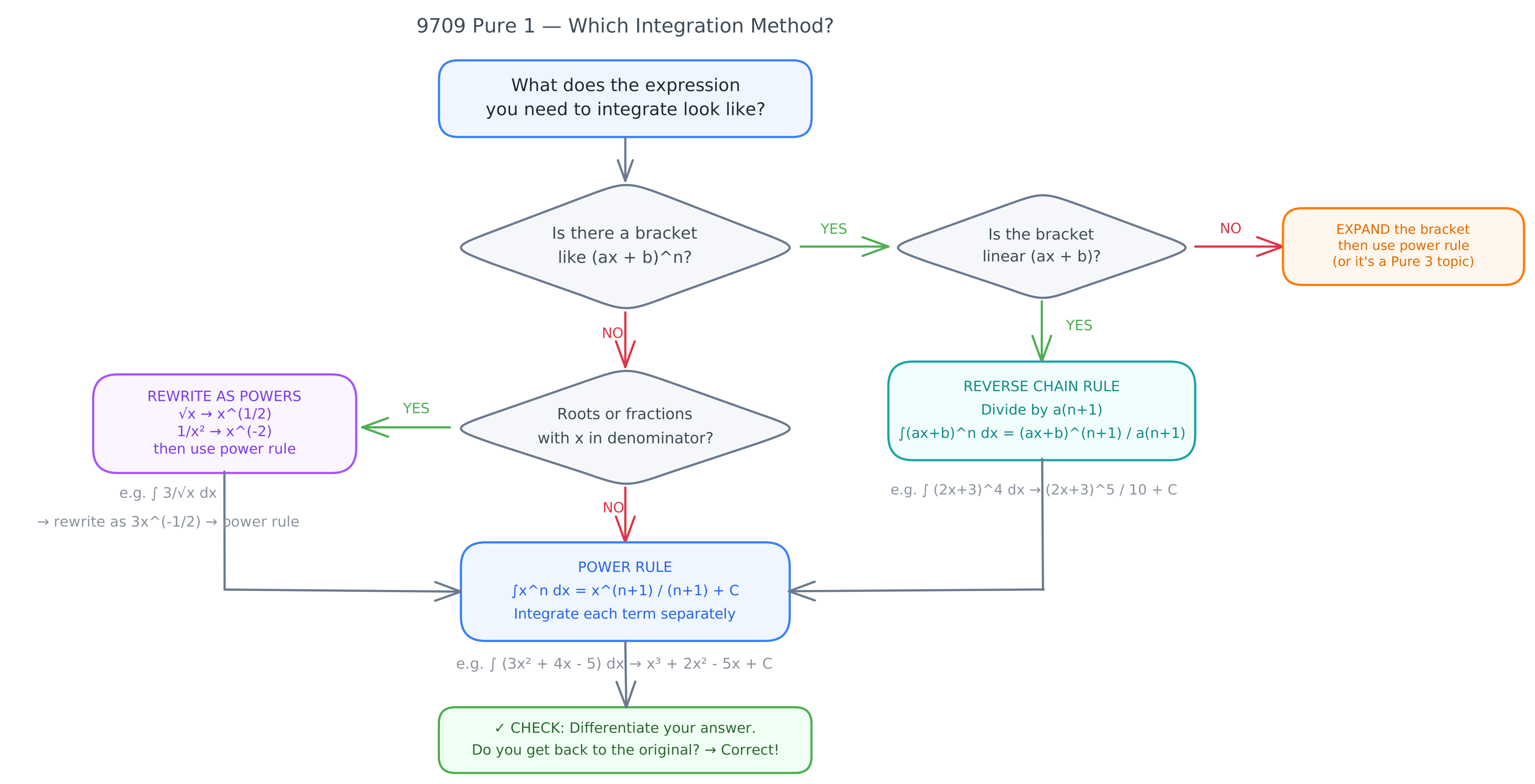
| Expression Type | Method | Example | Key Step |
|---|---|---|---|
| Individual powers of x | Power rule | ∫ 3x² dx | Add 1 to power, divide by new power |
| (ax + b)^n | Reverse chain rule | ∫ (2x+1)³ dx | Also divide by coefficient of x |
| Roots or fractions | Rewrite as powers, then power rule | ∫ 1/√x dx | Convert to x^(-1/2) first |
| Area questions | Set up definite integral | Area between curve and line | Find limits from intersections |
How to Check Your Answer in 30 Seconds
This is the single most powerful exam technique for 9709 integration, and almost nobody uses it consistently. Differentiate your answer. If you get back to the original expression, your integration is correct. If you don't, you've found your mistake before the examiner does.
This check works for every integration in Pure 1. It takes 30 seconds. Build the habit now and you'll catch errors before they cost marks.
3-Stage Revision Strategy
Stage 1 — Learn the rules (Days 1–3). Focus on the power rule and the reverse chain rule. Don't touch area questions yet. You need the mechanical skills to be automatic before you apply them.
Stage 2 — Practice with structure (Days 4–10). Work through sub-topics in this order: basic indefinite integrals, reverse chain rule, definite integrals, area under a curve, area between a curve and a line. Do five to eight questions per sub-topic before moving on. If you're getting more than one in four wrong, stay on that sub-topic.
Stage 3 — Exam simulation (Days 11+). Practice full 9709 integration questions under timed conditions. Use past papers by topic. Mark your work using the official mark scheme — this teaches you what examiners actually look for.
Frequently asked questions
Practise 9709 Integration with adaptive questions calibrated to your level
ExamPilot identifies your weak spots and targets them with adaptive, exam-specific practice.
No spam — just your invite.
By joining, you agree to receive emails from ExamPilot. Unsubscribe any time.