9709 Functions (Pure 1): Notes & Exam-Style Questions
- Functions
- 9709 Functions is the first major algebra topic in 9709 Pure 1, and it tests skills you'll use across the entire paper. For Cambridge 9709 Pure 1, Topic 1.2 of the Cambridge International AS & A Level Mathematics 9709 syllabus covers domain, range, one-one functions, inverse functions, composition of functions, and graph transformations. Functions questions appear on every Paper 1 as one of the longer, multi-part questions, worth around 8-12 marks. Understanding functions also feeds directly into differentiation and integration, making it foundational for the entire course.
ExamPilot maps your weak 9709 topics and drills them until they're not. Built for Cambridge 9709.
Practise functions with adaptive questions calibrated to your level
Free spot in our invite-only Closed Beta. Cambridge 9709 exams are in Oct/Nov. Get on the list now.
We'll never share your email.
By joining, you agree to receive emails from ExamPilot. Unsubscribe any time.
Key takeaways
- Cambridge 9709 Pure 1 functions covers domain, range, composite functions (fg), inverse functions (f⁻¹), and graph transformations.
- Finding the range of a function requires you to consider the restricted domain — a distinction most students miss until it costs marks in the exam.
- Inverse functions only exist when the original function is one-to-one. Cambridge examiners regularly test this with domain restriction questions.
- ExamPilot pinpoints your exact functions gap — notation confusion, domain errors, or transformation mistakes — and targets each one with adaptive practice.
This guide is part of our Complete Cambridge 9709 Pure 1 Revision Guide — your comprehensive resource for exam preparation.
What 9709 Functions Means in Pure 1
A function is a rule that takes an input and produces exactly one output. You've been using functions since GCSE — y = 2x + 3 is a function — but A-Level formalises the language. That language matters, because 9709 exam questions test whether you understand the terminology, not just whether you can do the algebra.
The modulus function |f(x)| is Pure 3 only. Don't waste revision time on it for Paper 1. Everything in this guide is strictly what the 2026 − 2027 syllabus requires for Pure Mathematics 1.
Core Functions Concepts
Domain and Range in 9709 Functions
Domain = what goes IN (the x-values the function accepts). Range = what comes OUT (the y-values the function actually produces).
For a linear function like f(x) = 2x + 1, the domain is all real numbers and the range is all real numbers. Quadratic functions are where it gets interesting. Take f(x) = x² − 4x + 7. Complete the square: f(x) = (x − 2)² + 3. The minimum value is 3 (when x = 2), so the range is f(x) ≥ 3.
Two notations appear in 9709: f(x) = 2x + 1 (most common) and f : x ↦ 2x + 1 (mapping notation). Both mean the same thing and the exam uses both interchangeably.
Composite Functions in 9709 Functions — fg(x) Explained
A composite function is a 'function of a function.' You feed the output of one function into another: fg(x) = f(g(x)).
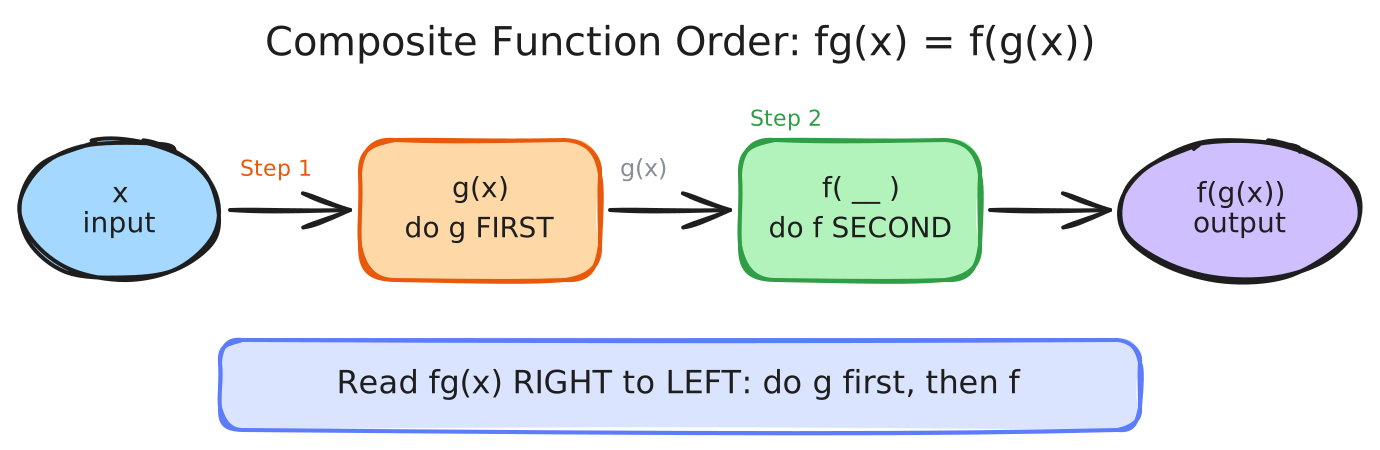
The order rule that trips everyone up: fg(x) means 'do g first, then f.' Read right to left. Think of it like getting dressed — 'socks then shoes' means you put socks on first, shoes second.
Example: f(x) = x², g(x) = x + 3. Then fg(x) = f(g(x)) = f(x + 3) = (x + 3)². But gf(x) = g(f(x)) = g(x²) = x² + 3. Completely different results.
Inverse Functions in 9709 Functions — Finding f⁻¹(x)
An inverse function 'undoes' what the original function does: ff⁻¹(x) = f⁻¹f(x) = x. An inverse only exists for one-one functions.
To find the inverse: (1) Write y = f(x). (2) Swap x and y. (3) Rearrange to make y the subject. (4) Replace y with f⁻¹(x). (5) State the domain (= range of original f).
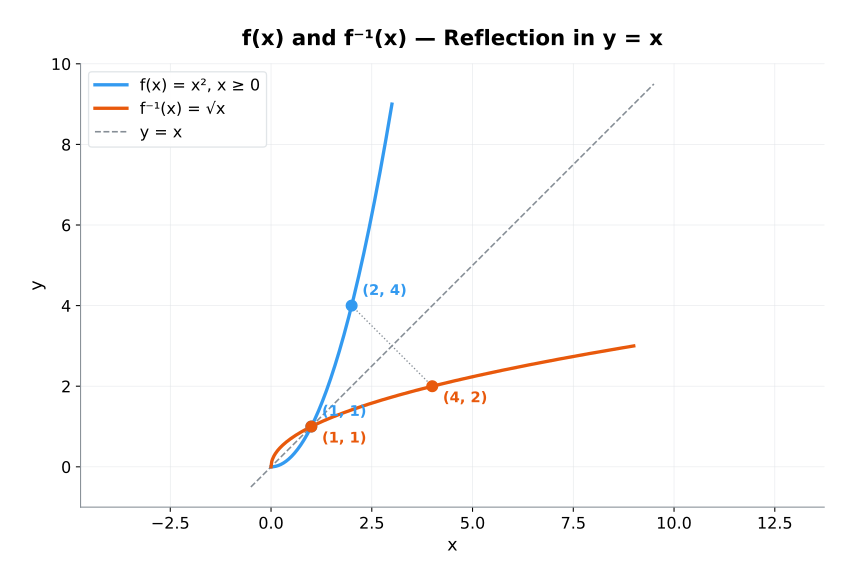
The graph of f⁻¹(x) is the reflection of f(x) in the line y = x. If a question asks you to solve f(x) = f⁻¹(x), do not assume you can simply solve f(x) = x — this only finds solutions that happen to lie on y = x, and there may be others. The safest method is always to solve f(x) = f⁻¹(x) directly and algebraically.
How Functions Connects to Other Topics
Functions isn't isolated — it's the language that every other Pure 1 topic uses.
Differentiation: When you differentiate f(x) = x³ − 2x, you're finding f'(x). The chain rule for differentiating composite functions like (2x + 1)⁵ directly uses the concept of composition. If you understand fg(x), the chain rule makes more sense. See our 9709 Differentiation for more.
Integration: Integration is the reverse of differentiation, which is the same idea as an inverse function. The definite integral also requires understanding domain restrictions — you can only integrate over an interval where the function is defined. See our 9709 Integration for the full method.
Quadratics: Completing the square to find the range of a quadratic function is pure functions territory. If you are not confident completing the square, that's worth revisiting in our 9709 Quadratics — it appears in almost every functions question involving range or inverse.
Trigonometry: Graph transformations apply directly to trig graphs. When you meet y = 3sin(2x) + 1, you're applying a vertical stretch (scale factor 3), a stretch of scale factor ½ parallel to the x-axis (this halves the period — the graph gets narrower), and a vertical translation of +1 to y = sin(x). Apply the translation last. See our 9709 Trigonometry for more on trig graph transformations.
What to Do Next
9709 functions is the language of the entire course. Master the terminology (domain, range, one-one, many-one), the methods (finding inverses, forming composites, applying transformations), and the exam techniques (stating domains, using correct vocabulary, showing working), and you've built the foundation for everything else in Pure 1.
Cambridge 9709 examiner reports consistently flag the same three sources of lost marks in functions: getting composite function order wrong (fg vs gf), forgetting to state the domain of f⁻¹, and using incorrect transformation vocabulary. All three are avoidable with careful practice.
ExamPilot's adaptive practice identifies exactly which functions sub-skills you need to work on. Instead of grinding through random questions, you practice the ones that target your specific gaps.
Functions feeds directly into the next major topic. Read our 9709 Differentiation to see how function notation and the chain rule connect.
Key formulas
Composite Functions
The function closest to x acts first. fg(x) means: feed x into g, then feed the result into f. Think of it like getting dressed — 'socks then shoes' means socks go on first.
Inverse Functions
To find the inverse: write y = f(x), swap x and y, rearrange for y, then replace y with f⁻¹(x). Always state the domain of f⁻¹ (it equals the range of the original f).
Graph Transformations
Worked examples
Finding the range of a quadratic function
Composite functions — fg(x)
Finding the inverse of a linear function
Finding the inverse with restricted domain
Self-inverse function proof
Describing graph transformations
Domain of a composite function
Multi-part functions question
Common mistakes
Getting fg(x) and gf(x) the wrong way round — applying f first instead of g
fg(x) means do g first, then f. Read right to left: fg(x) = f(g(x)). The function closest to x acts first. Examiner reports flag this as the most common procedural error in functions questions.
Saying a function has no inverse because of domain issues, not because it's not one-one
A function needs to be one-one (passes horizontal line test) for an inverse to exist. A significant number of candidates incorrectly stated the function was undefined, rather than identifying that it was not one-one. Understand the difference.
Forgetting to state the domain of f⁻¹(x)
The domain of f⁻¹ equals the range of the original f. This is a free mark — always state it. If f has domain x ≥ 2 and range y ≥ 5, then f⁻¹ has domain x ≥ 5.
Graph transformation direction errors — thinking f(x+3) shifts right
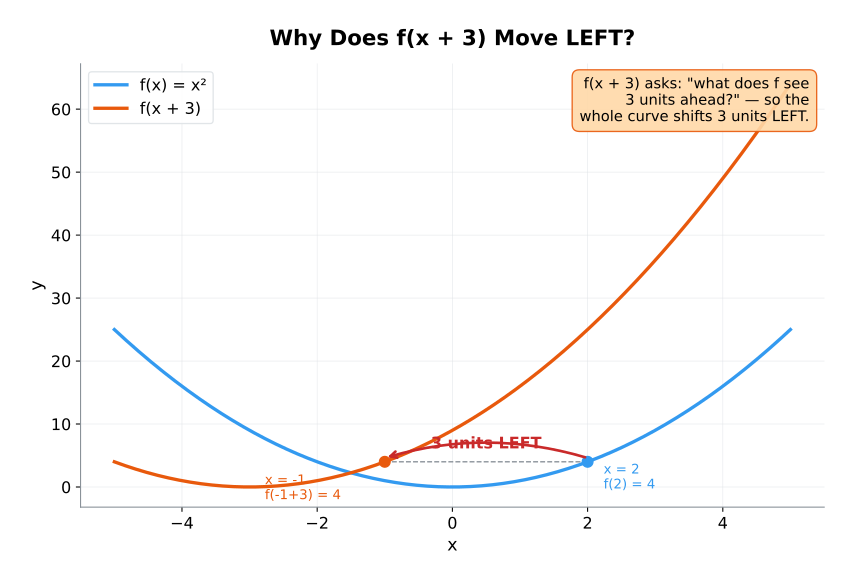
Changes inside f() affect x and are OPPOSITE to what you expect: f(x+3) shifts LEFT by 3, f(2x) is a horizontal stretch by factor 1/2. Changes outside f() affect y and do what you expect: f(x)+3 shifts UP by 3.
Not using correct transformation vocabulary — saying 'shift' instead of 'translation'
The 9709 syllabus explicitly requires the terms 'translation', 'reflection', and 'stretch'. Using 'shift', 'flip', or 'squash' loses marks even if the description is otherwise correct.
Exam tips
The Inside-Outside Rule for Transformations
Changes outside f() affect y and do what you expect: f(x)+3 shifts up by 3, 2f(x) stretches vertically by factor 2. Changes inside f() affect x and are opposite: f(x+3) shifts LEFT by 3, f(2x)is a stretch of scale factor ½ parallel to the x-axis.
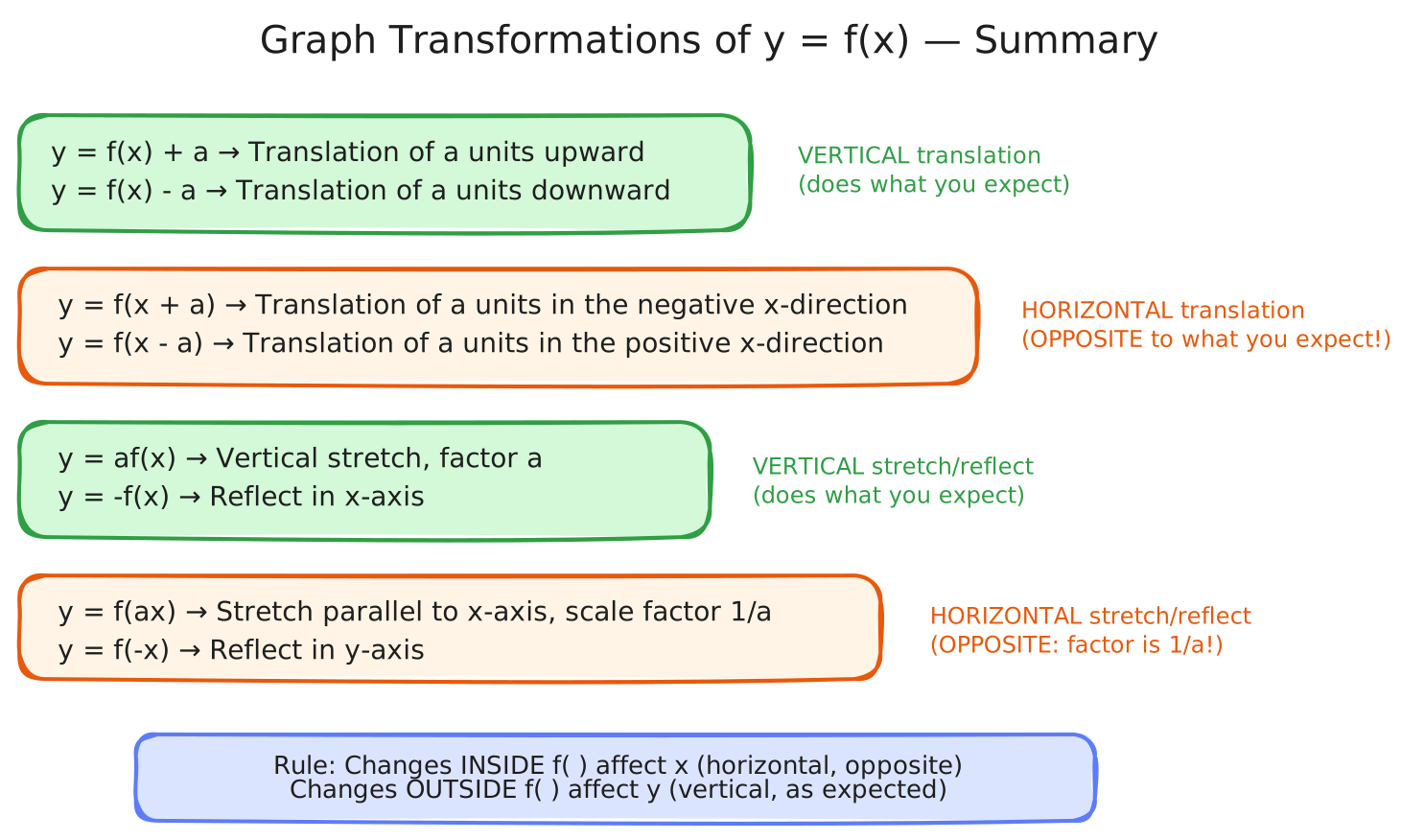
| Transformation | Equation | Description | Direction |
|---|---|---|---|
| Vertical translation | y = f(x) + a | Translate up by a | As expected |
| Vertical translation | y = f(x) − a | Translate down by a | As expected |
| Horizontal translation | y = f(x + a) | Translate left by a | Opposite |
| Horizontal translation | y = f(x − a) | Translate right by a | Opposite |
| Vertical stretch | y = af(x) | Stretch parallel to y-axis, scale factor a | As expected |
| Horizontal stretch | y = f(ax) | Stretch parallel to x-axis, scale factor 1/a | Opposite |
| Reflection in x-axis | y = −f(x) | Reflection in the x-axis | — |
| Reflection in y-axis | y = f(−x) | Reflection in the y-axis | — |
Read Right to Left for Composites
fg(x) means do g first, then f. The function closest to x acts first. Write it as f(g(x)) every time until the order becomes automatic. Cambridge examiners flag this as the most common procedural error in functions questions.
Why f(x+3) Moves LEFT
f(x+3) asks 'what does f see 3 units ahead?' At x = 2, f(x+3) evaluates f(5). The output that used to happen at x = 5 now happens at x = 2. The whole curve arrives 3 units sooner, so it shifts left.
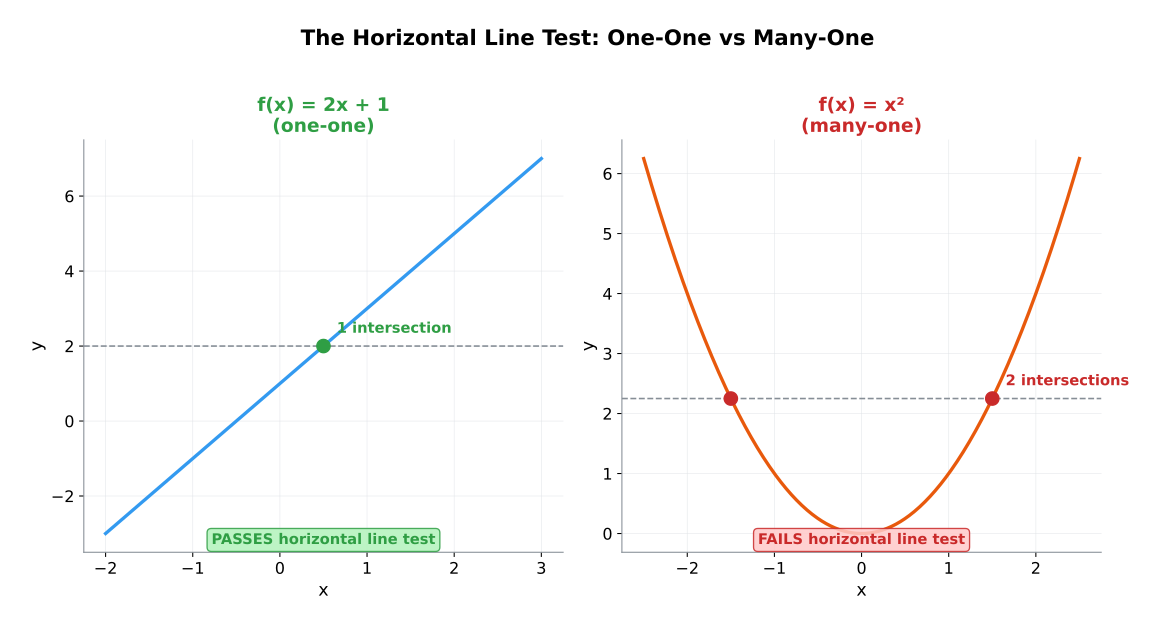
The Horizontal Line Test
An inverse only exists for one-one functions. Use the horizontal line test: if any horizontal line crosses the graph more than once, the function is many-one and has no inverse unless you restrict the domain.
3-Stage Revision Strategy
Stage 1 (2-3 sessions): Master the concepts — domain/range, notation, the inverse method, and the composite method. Don't move on until you can explain each concept without notes.
Stage 2 (3-4 sessions): Apply to exam contexts — do past paper functions questions by sub-topic. Start with inverse function questions, then composites, then transformations. Check your answers against mark schemes.
Stage 3 (ongoing): Timed mixed practice — mix all sub-topics together under timed conditions. Functions questions in the actual exam combine concepts, so practising mixed questions builds the fluency that scores full marks.
Frequently asked questions
Practise 9709 Functions with adaptive questions calibrated to your level
ExamPilot identifies your weak spots and targets them with adaptive, exam-specific practice.
No spam — just your invite.
By joining, you agree to receive emails from ExamPilot. Unsubscribe any time.