9709 Quadratics (Pure 1): Notes & Practice Questions
- Quadratics
- 9709 Quadratics covers completing the square, the discriminant, hidden quadratics, quadratic inequalities, and simultaneous equations. In the Cambridge International AS & A Level Mathematics 9709 syllabus, Topic 1.1 treats quadratic techniques not as standalone skills but as tools that recur across coordinate geometry, functions, trigonometry, and differentiation. Quadratics directly accounts for 5-8 marks out of 75 on Paper 1, but quadratic techniques appear embedded in 30+ marks of other topic questions.
ExamPilot maps your weak 9709 topics and drills them until they're not. Built for Cambridge 9709.
Practise quadratics with adaptive questions calibrated to your level
Free during beta. No card needed.
We'll never share your email.
By joining, you agree to receive emails from ExamPilot. Unsubscribe any time.
Key takeaways
- Cambridge 9709 Pure 1 quadratics´ syllabus covers solving by factorisation, completing the square, and the quadratic formula, plus the discriminant (b²−4ac) and its interpretation.
- Completing the square is tested both as a solving method and as a route to finding the vertex form — expect questions that require both uses in the same part.
- The discriminant tells you the number of real roots: positive = two distinct roots, zero = one repeated root, negative = no real roots.
- ExamPilot tracks which quadratic method you drop marks on most — factorising, completing the square, or the formula — and adjusts practice until all three are exam-solid.
This guide is part of our Complete Cambridge 9709 Pure 1 Revision Guide.
What Cambridge 9709 Quadratics Actually Tests
A quadratic is any expression of the form ax² + bx + c where a ≠ 0. Cambridge 9709 tests three solution methods — factorisation, completing the square, and the quadratic formula — plus the discriminant and disguised quadratics.
You can already solve 9709 Quadratics. Factorising, the quadratic formula, sketching parabolas — you've covered all of that at GCSE. So what makes the Cambridge 9709 version different? The short answer: 9709 doesn't test whether you can solve quadratics. It tests whether you can use quadratic techniques as tools inside other problems. The discriminant proves a line is tangent to a curve. Completing the square is also the technique that rewrites a circle equation into centre-radius form in coordinate geometry — one example of how this quadratic skill recurs across other topics. A trigonometry question that looks nothing like a quadratic turns out to be one in disguise.
What's in scope for Paper 1
- Completing the square: express ax² + bx + c in the form a(x + p)² + q
- The discriminant b² −4ac and conditions for real, equal, and no real roots
- Solving quadratic equations by factorising, completing the square, and the formula
- Solving quadratic inequalities
- Solving simultaneous equations where one is linear and one is quadratic
- Recognising and solving equations that are quadratic in some function of x (hidden quadratics), e.g. x⁴ − 5x² + 4 = 0 or tan²x = 1 + tan x
What's NOT in Pure 1 scope: partial fractions (Pure 3), complex roots (Further Maths). Papers 11, 12, and 13 are simply the three variants of Paper 1 — if you're sitting any of them, the content is identical across all three. The focus is on quadratic techniques as tools applied within other topics.
Core Quadratics Techniques
Completing the Square — The Skill That Unlocks Everything
Completing the square is the single most transferable quadratic technique in Pure 1. The method converts ax² + bx + c into vertex form a(x + p)² + q, which gives you the turning point directly. It appears in quadratics questions, circle equations in coordinate geometry, range of functions, and maximum/minimum problems. Get this right and you unlock marks across half the paper.
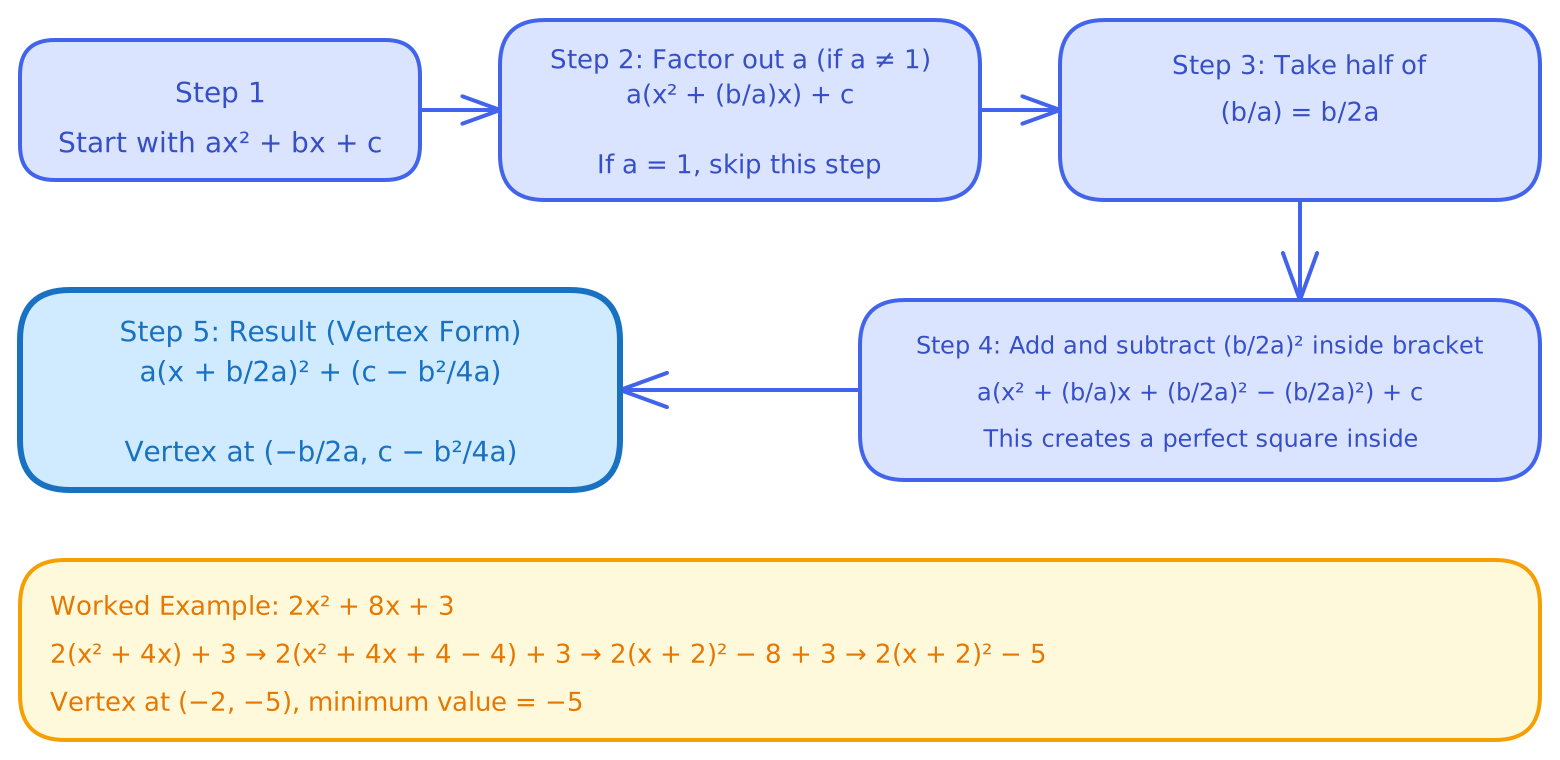
When written in the form a(x + p)² + q, the vertex form gives the turning point directly at (−p, q). For a monic quadratic (leading coefficient 1), halve the coefficient of x, square it, and adjust. For a non-monic quadratic, factor out the leading coefficient first. This means you can sketch the parabola, find the range of a function, or identify the maximum/minimum without differentiation.
The Discriminant in Action
The discriminant is not a formula to memorise and apply mechanically. It is a decision tool that tells you what kind of solutions an equation has. The three conditions — greater than zero, equal to zero, less than zero — each have different geometric interpretations and appear across at least four different topic areas in 9709.
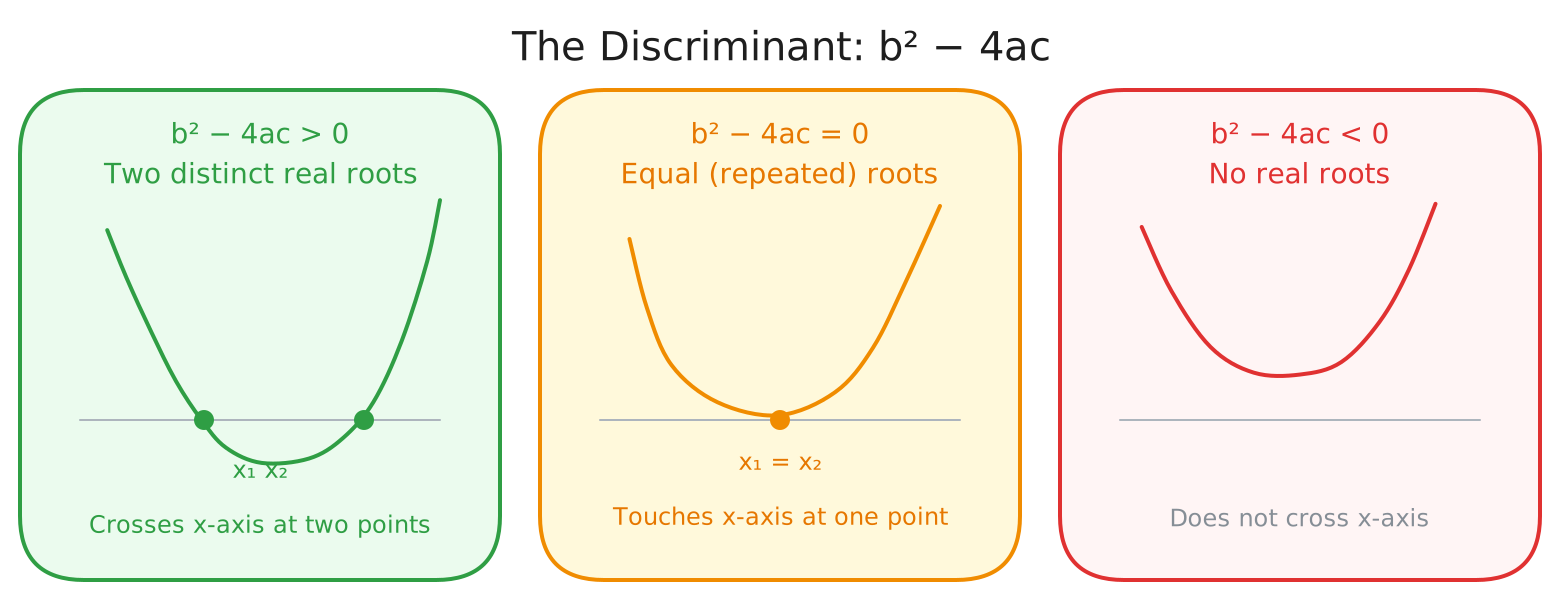
In coordinate geometry: 'Show that the line is a tangent to the curve' means substitute, rearrange, and set b² − 4ac = 0 because a tangent touches at exactly one point. In functions: 'Find the range of values of k for which f(x) = k has no solutions' means set f(x) = k, rearrange into a quadratic, and apply b² − 4ac < 0. In 'find the values of k' questions, identify a, b, c in terms of k, set the appropriate discriminant condition, and solve the resulting equation or inequality.
Hidden Quadratics — Spotting the Disguise
Hidden quadratics are the distinctly A-Level concept that GCSE didn't prepare you for. These are equations that don't look like quadratics but become quadratics after a substitution. The trick is recognition: any equation where the powers of the three terms are in the ratio 2 : 1 : 0 can be reduced by substitution. It appears in trigonometry, exponentials, and algebraic questions — often without any hint that there's a quadratic involved.
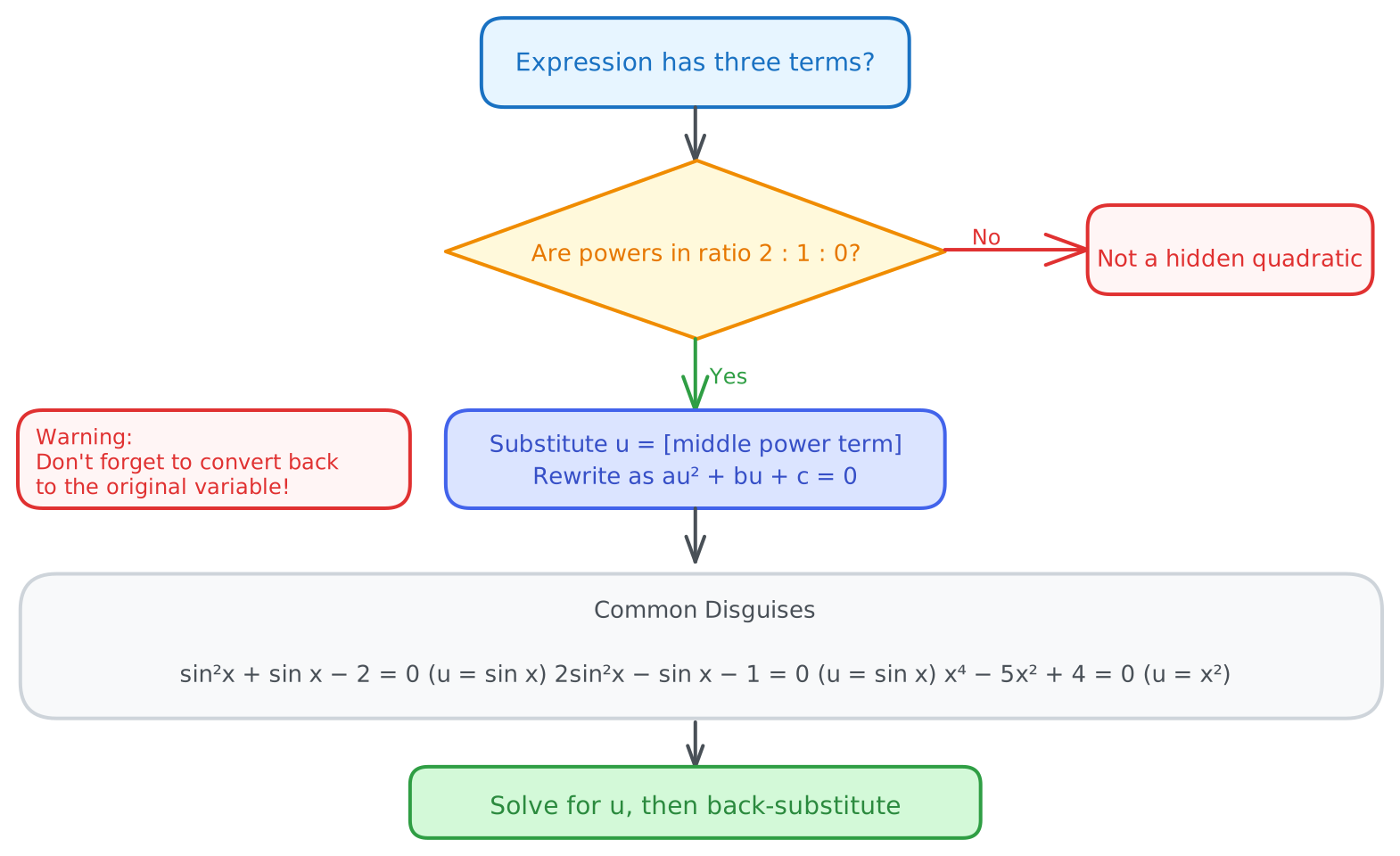
The substitution checklist: (1) Identify the 'base' expression (e.g. sin x, x²). (2) Check the powers — is the first term the square of the second? (3) Substitute u = [base expression]. (4) Solve the quadratic in u. (5) Convert back to the original variable. (6) Check validity — reject solutions outside the domain. Step 6 is where marks are lost. If u = sin x, then −1 ≤ u ≤ 1.
Quadratic Inequalities — The Sketch Method
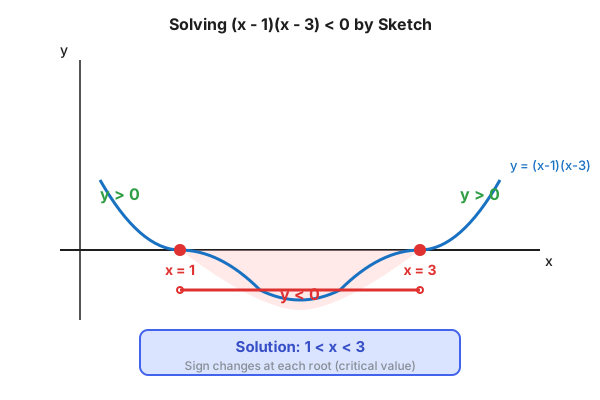
The reliable method for quadratic inequalities: (1) Solve the corresponding equation to find the critical values. For x² − 5x + 6 = 0, factorise to get x = 2 and x = 3. (2) Sketch the parabola — positive x² coefficient means it opens upward, negative means downward. (3) Mark the roots on the x-axis. (4) Read the inequality from the graph — shade above the x-axis for 'greater than zero,' shade below for 'less than zero.' For x² − 5x + 6 > 0, the solution is x < 2 or x > 3. For x² − 5x + 6 < 0, the solution is 2 < x < 3.
How Quadratics Connects to Every Other Topic
Quadratics is the most foundational topic in Pure 1. It doesn't just appear in the 'quadratics' question — it's everywhere. Cambridge 9709 examiner reports show that errors in completing the square and discriminant interpretation cascade into circle geometry, functions, and coordinate geometry questions — a gap here costs marks across the whole paper. Master completing the square and the discriminant, and you have tools that earn marks in at least four other topics besides quadratics itself.
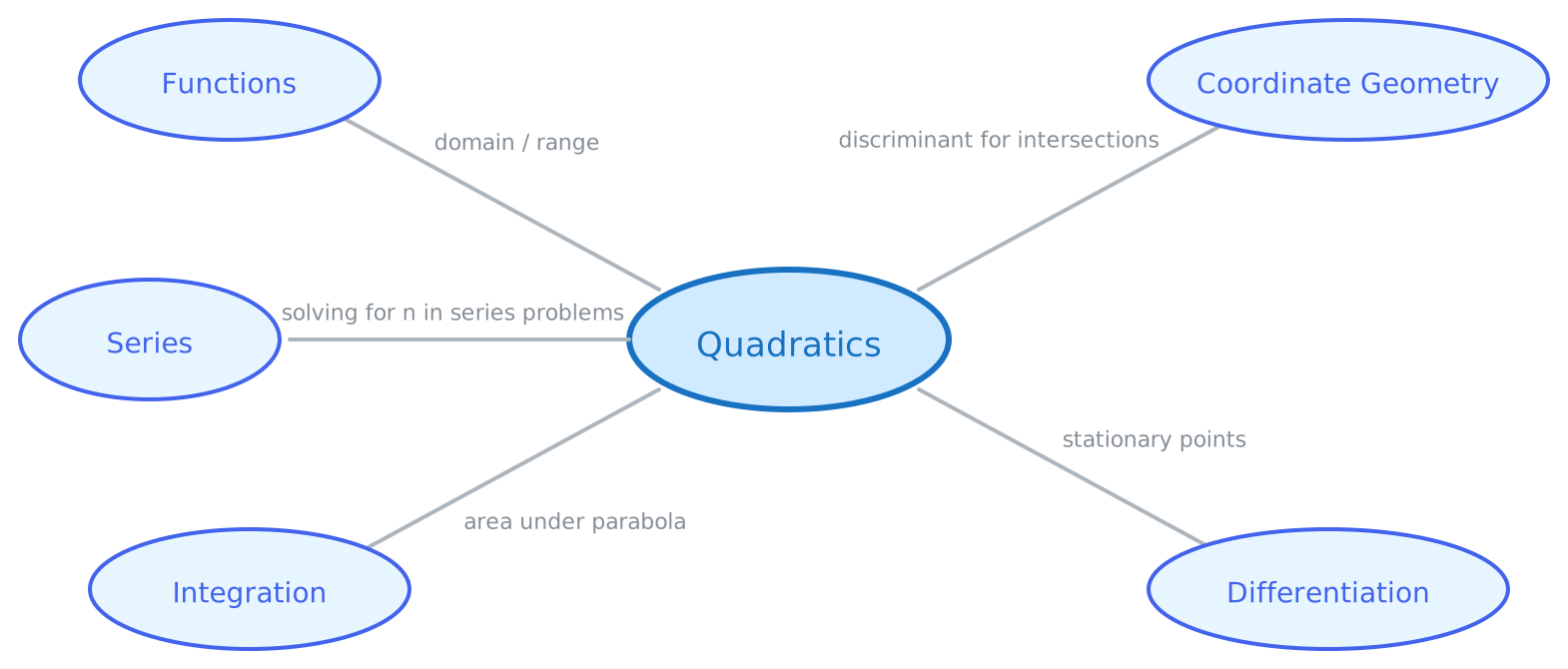
The discriminant condition for tangents (b² − 4ac = 0) is tested in coordinate geometry questions almost every session. Completing the square converts general circle equations to centre-radius form. See our 9709 coordinate geometry guide for the full method.
Completing the square and the discriminant appear when finding where a curve meets a line — a setup that also arises in integration questions. See our Cambridge 9709 Integration.
Hidden quadratics appear in trigonometry equations like sin²x + 3sin x + 2 = 0. The substitution technique is identical. See our Cambridge 9709 Trigonometry for worked examples.
Vertex form from completing the square gives you the range of quadratic functions directly. See our 9709 Functions for range and domain methods.
Setting a derivative equal to zero to find stationary points often produces a quadratic to solve. See our 9709 Differentiation for optimisation problems.
Binomial expansion problems sometimes produce equations where equating coefficients gives you a quadratic to solve — the same techniques apply. See our Cambridge 9709 Binomial Series.
What to Do Next
Master completing the square first — including negative coefficients — because it appears the most frequently and errors here cascade into other topics. Then learn the three discriminant conditions and where each one applies. Build your pattern recognition for hidden quadratics after that. Those three skills unlock marks across half the paper. Paper 1 carries 75 marks out of 250 total for the full A-Level. Quadratic techniques touch the majority of those 75 marks. The time you invest here pays off everywhere.
Ready to practise quadratics with questions calibrated to your level? Get early access for adaptive A-Level Maths practice.
Key formulas
Completing the Square
The vertex form a(x + p)² + q, where p = b/2a and q = c − b²/4a, gives the turning point directly at (−p, q). No calculus needed. This same technique converts general circle equations to centre-radius form in coordinate geometry — complete the square on both x and y separately to find the centre and radius.
Completing the Square with Negative Leading Coefficient
Factor out the negative sign FIRST, then complete the square inside the bracket. The most common error is writing -9 - 5 instead of +9 - 5 when distributing the negative sign. Sign errors with negative leading coefficients are among the most commonly reported mistakes in Cambridge examiner reports. Always distribute the factored-out coefficient back through before moving on, and verify by expanding your answer.
The Quadratic Formula
Completing the square and the quadratic formula are different tools for different jobs. Completing the square gives you the vertex form, which you need for finding the range of a function, the turning point of a curve, and converting circle equations. The quadratic formula finds roots directly and is faster when the coefficients are awkward. You need both for 9709.
The Discriminant
The discriminant is not just a formula to memorise. It is a decision tool that appears across at least four topic areas: coordinate geometry (tangent conditions — set b² − 4ac = 0), functions (range problems — set b² − 4ac < 0), quadratics ('find the values of k' questions), and trigonometry (checking validity after hidden quadratic substitution).
Quadratic Inequalities
Find the critical values (roots) first by solving the corresponding equation. Then sketch the parabola — check whether the coefficient of x² is positive (opens upward) or negative (opens downward). Mark the roots on the x-axis and read the inequality from the graph. The sketch method is more reliable than working algebraically from the factorised form because it makes the solution range visually obvious and avoids the common error of treating the inequality as an equation.
Worked examples
Completing the Square (Monic)
Completing the Square (Negative Leading Coefficient)
Using the Discriminant to Find k
Hidden Quadratic (Trigonometric)
Quadratic Inequality
Simultaneous Equations (Quadratic-Linear)
Common mistakes
Sign errors when completing the square, especially with negative leading coefficients
Factor out the negative sign FIRST: −x² + 6x − 5 becomes -(x² − 6x) − 5. Then complete the square inside the bracket. The most common error is writing −9 − 5 instead of +9 − 5 when distributing the negative sign. Cambridge examiner reports note that sign errors when completing the square were widespread, particularly when the coefficient of x² was negative. Always write each step on a new line, distribute the factored-out coefficient back through, and verify by expanding your answer.
Applying the wrong discriminant condition (using > 0 when = 0 is needed)
Tangent, 'touches,' or 'equal roots' all mean b² − 4ac = 0, NOT > 0. Two distinct real roots means > 0. No real roots means < 0. Examiner reports flag this confusion every session, as many candidates stated b² − 4ac > 0 when the question required equal roots (2022). Learn all three conditions as a set, and read the question for the exact wording before selecting the condition.
Not checking hidden quadratic solutions against the domain
After solving a hidden quadratic, always convert back and check validity. If u = sin x, then u must be between −1 and 1 — reject sin x = 3. The examiner report notes that candidates who found both solutions of the quadratic but failed to reject the invalid one lost the final mark (2024). Always apply step 6 of the substitution checklist.
Solving a quadratic inequality as an equation (writing x = ... instead of a range)
A quadratic inequality has a range as its answer, not specific values. If x² − 5x + 6 < 0, the answer is 2 < x < 3, NOT x = 2 or x = 3. Always sketch the parabola and shade the correct region. Cambridge examiners note that a significant number of candidates gave the critical values as the answer rather than the inequality (2023). Check the mark scheme — examiners require the inequality notation, not just the critical values.
Confusing completing the square with solving the equation
Completing the square converts to vertex form a(x + p)² + q. Solving finds roots. When the question asks to 'express in the form a(x + p)² + q,' do NOT set the expression equal to zero. 'Express in the form' and 'solve' are different instructions. Students lose marks by completing the square correctly and then writing x = ... when the question only asked for the form.
Exam tips
How to Spot a Hidden Quadratic
Hidden quadratics — also known as disguised quadratics — are equations that don't look like quadratics but become quadratics after a substitution. The pattern to recognise: three terms where the power of the first term is twice the power of the second. This is the A-Level concept that GCSE didn't prepare you for. It appears in trigonometry and algebraic questions — often without any hint that there's a quadratic involved.
| Original Equation | Substitution | Quadratic Form |
|---|---|---|
| sin²x + 3sin x + 2 = 0 | Let u = sin x | u² + 3u + 2 = 0 |
| 2sin²x − sin x − 1 = 0 | Let u = sin x | 2u² − u − 1 = 0 |
| x⁴ − 5x² + 4 = 0 | Let u = x² | u² − 5u + 4 = 0 |
| x + 1/x = 5 | Multiply by x, rearrange | x² − 5x + 1 = 0 |
The Discriminant as a Decision Tool
The discriminant isn't just a quadratics tool. It appears across at least four other topics in 9709. Students who learn it only as a formula to apply in quadratics questions miss its power as a problem-solving tool that earns marks in coordinate geometry, functions, and trigonometry.
| Topic | Exam Phrasing | Discriminant Condition |
|---|---|---|
| Coordinate Geometry | "Show the line is a tangent to the curve" | b² − 4ac = 0 |
| Functions | "Find the range of k for which f(x) = k has no solutions" | b² − 4ac < 0 |
| Quadratics | "Find the values of k for which the equation has two distinct real roots" | b² − 4ac > 0 |
| Trigonometry | Hidden quadratic after substitution — check for valid roots | b² − 4ac ≥ 0 and domain check |
The Sketch Method for Quadratic Inequalities
The reliable method for quadratic inequalities: (1) Solve the corresponding equation to find the critical values (roots). (2) Sketch the parabola — is the coefficient of x² positive (opens upward) or negative (opens downward)? (3) Mark the roots on the x-axis. (4) Read the inequality from the graph — shade above the x-axis for 'greater than zero,' shade below for 'less than zero.' Examiners give full credit for a clearly labelled sketch.
Revision Strategy for Quadratics
Priority order: (1) Completing the square — used in quadratics, functions, and coordinate geometry. Start here because it appears the most frequently and errors cascade into other topics. (2) Discriminant conditions — used in coordinate geometry, functions, and trigonometry. Move here once completing the square is reliable. (3) Hidden quadratics — used in trigonometry and algebraic questions. (4) Quadratic inequalities — tested as a standalone skill. You can drill hidden quadratics and inequalities in parallel. Stage 1: learn the methods. Stage 2: practise set-piece questions, five to eight per sub-topic. Stage 3: timed past papers under exam conditions.
Frequently asked questions
Practise 9709 Quadratics with adaptive questions calibrated to your level
ExamPilot identifies your weak spots and targets them with adaptive, exam-specific practice.
No spam — just your invite.
By joining, you agree to receive emails from ExamPilot. Unsubscribe any time.