9709 Common Mistakes: What Cambridge Examiners Flag Every Session
9709 common mistakes aren't knowledge gaps. They're execution habits — the same handful that Cambridge examiners flag, session after session, in their principal examiner reports.
Examiner report commentary puts the cost at roughly 10 marks or more per paper, lost not to weak topics but to missing working, incomplete solution sets, sign errors, and premature rounding. On a 75-mark paper, that's often the gap between the grade a student is capable of and the grade on their certificate.
If that sounds familiar, this guide is for you.
These are not generic A-Level maths tips recycled from revision websites. These are the specific 9709 common mistakes that Cambridge examiners document, session after session, in their principal examiner reports — organised by topic, with the fix for each one.
Cambridge 9709 is taken in over 160 countries. The examiner reports are free, publicly available, and written by the people who mark your paper. This guide turns ten of their most consistent observations into a checklist you can act on before your next exam. For a deeper look at what five years of Pure 1 examiner reports actually say, session by session, see our examiner report analysis
Want a system that tracks exactly where you lose marks?
The Exam Readiness Index shows your accuracy by topic so you can see execution errors, not just knowledge gaps.
By joining, you agree to receive emails from ExamPilot. Unsubscribe any time.
Key takeaways
- Not showing working is the single most widespread mistake in 9709 Pure 1 — Cambridge examiner reports note it can cost most or all of the marks on a question, even when the final answer is correct.
- Execution errors, not knowledge gaps, cost students roughly 10 marks or more per paper, according to examiner report commentary — often the difference between a predicted grade and the grade actually achieved.
- The most common trigonometry mistake is stopping after finding one solution when the interval requires two or three — a mark lost to an incomplete solution set, not an incorrect method.
- Circular measure and integration losses are almost always mechanical — forgetting the chord in a segment's perimeter, or dropping the constant of integration (+C) — and both are fixable with one habit change, not more revision.
How Cambridge Marks Your Paper – M, A, and B Marks
Before looking at specific mistakes, you need to understand how marks are awarded. Many students think of marks as binary – right answer gets marks, wrong answer gets zero. That is not how Cambridge 9709 works. Cambridge mark schemes for 9709 Mathematics commonly use three mark codes – M, A and B – and understanding how they work changes how you approach every question.
| Mark Type | Name | What It Means | Key Implication |
|---|---|---|---|
| M | Method | Awarded for correct approach, even if the final answer is wrong | You can earn M marks with a wrong answer -- but only if working is shown |
| A | Accuracy | Awarded only if the preceding method mark is correct | Depends on M marks -- no method shown means no accuracy marks either |
| B | Specific result | Awarded for a specific correct statement, result, or conclusion, sometimes subject to stated conditions | You can sometimes earn B marks even if earlier work is wrong, but they may still depend on using the correct method or information given |
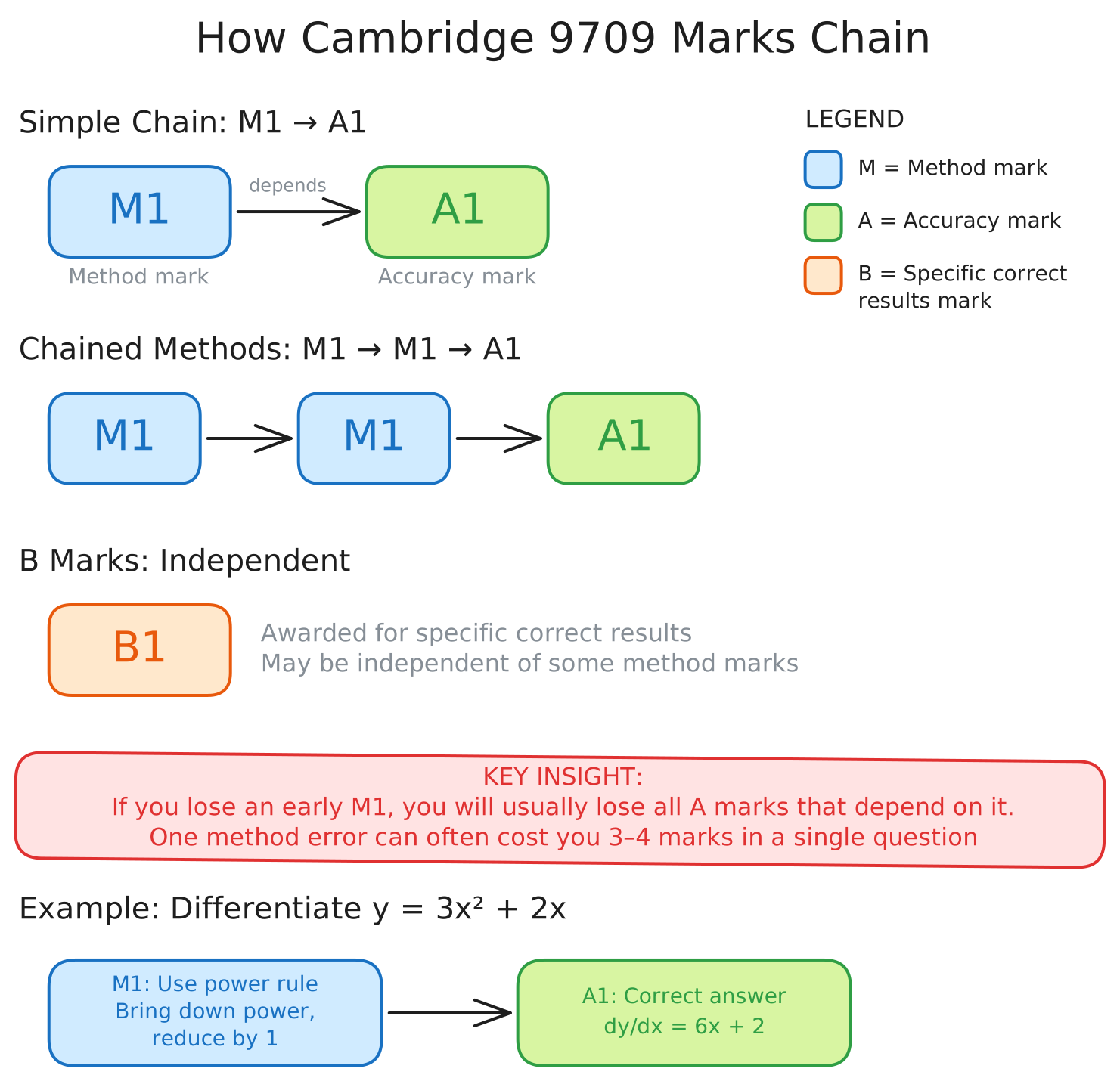
The critical insight: M marks reward your method, not your answer. On a four-mark question structured as M1 A1 M1 A1, showing the correct approach for both steps clearly can earn you two M marks even if later arithmetic errors produce a wrong final answer. Skip the working and write only the answer – even the correct answer – and you risk earning zero. The examiner cannot verify your method if you do not show it. Cambridge examiner reports from 2018 to 2024 consistently identify 'insufficient working shown' as the most widespread issue across all papers. It is not a topic-specific mistake. It is a working-discipline problem that costs marks on every question.
Pure 1 Common Mistakes (Topics 1.1-1.8)
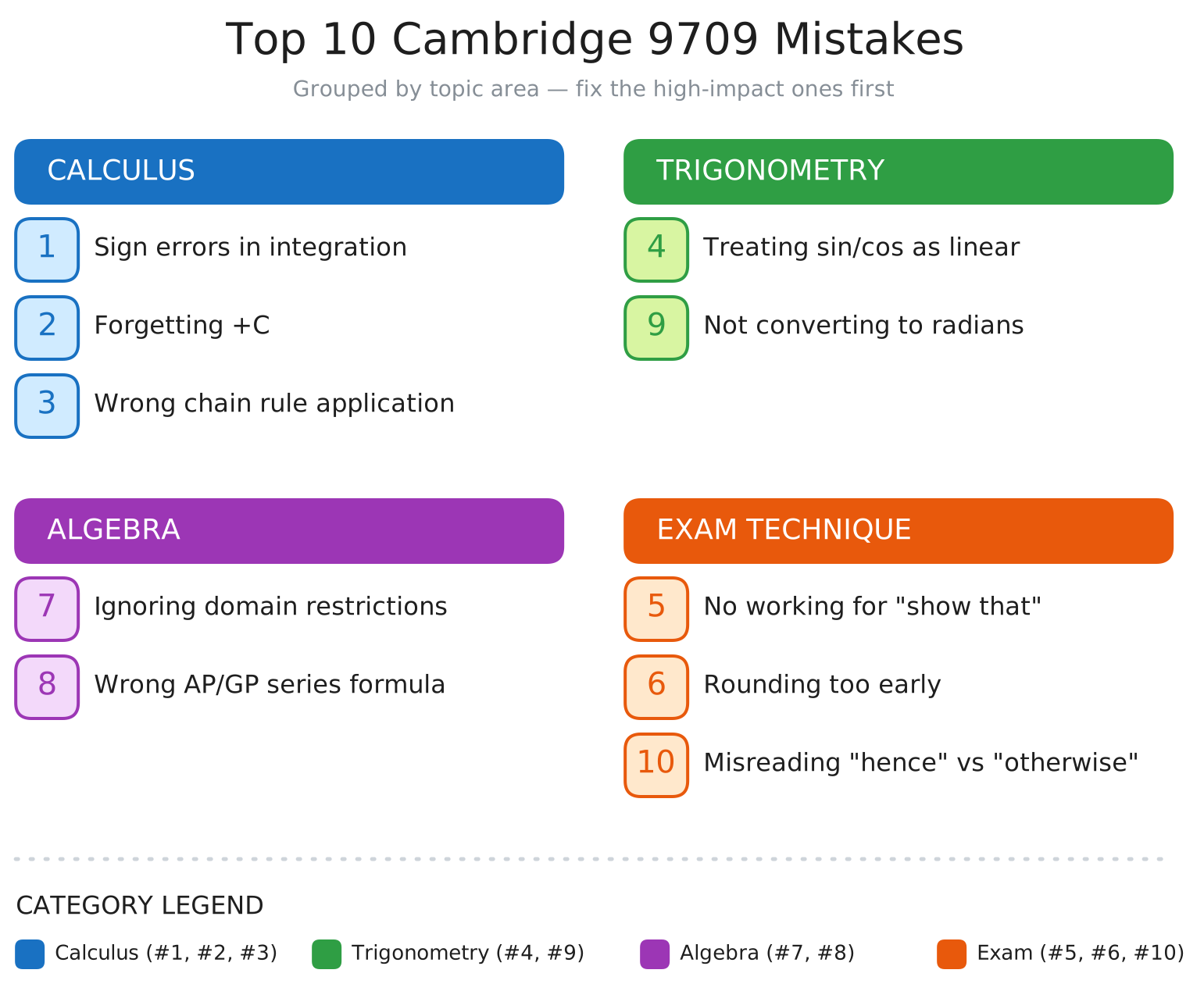
If you want to revise these topics systematically, start with our Cambridge 9709 Pure 1 Guide, which walks through quadratics, functions, coordinate geometry, circular measure, trigonometry, series, differentiation, and integration with exam‑style examples.
Mistake 1 – No Working Shown (All Questions)
This happens because of calculator dependence. Students reach for the calculator, get the right number, and write it down. Under time pressure, writing out algebraic steps feels like wasted effort. It is not. The fix: every algebraic step gets its own line. Every integral shows the integration step before evaluation. Every derivative shows the rule you applied. If you cannot point to a line of working that justifies each mark on the question, you have not written enough. A useful test – could someone follow your solution without seeing the question? If the answer is no, add more working.
If integration is where you skip the most working, review our Cambridge 9709 Pure 1 Integration guide to see exactly how each algebraic line should look.
Mistake 2 – Only One Trig Solution (Trigonometry)
The fix: always ask yourself 'how many solutions should there be?' For a standard sin or cos equation in [0, 360], expect two solutions. For equations involving 2x or 3x, expect more. Sketch the graph or use a CAST diagram to identify every solution systematically. For example, sin θ = 0.5 in [0, 360] gives θ = 30 and θ = 150. Writing only θ = 30 loses you a mark – and the examiner report will describe it as an 'incomplete solution set.' Our Cambridge 9709 Pure 1 Differentiation guide covers the CAST method and solution-counting in detail.
Mistake 3 – Sign Errors in Differentiation (Differentiation)
Students attempt to differentiate roots and reciprocals directly without first converting to power notation. Differentiating 1/x² as a fraction is error-prone. Differentiating x⁻² is mechanical. The fix: always rewrite before differentiating. 1/x becomes x⁻¹. 1/x² becomes x⁻². √x becomes x½. Then apply the power rule – bring the power down, reduce by one. The signs follow naturally from the algebra rather than from mental arithmetic.
Mistake 4 – Forgetting +C (Integration)
Students focus on the integration technique – getting the power rule right, handling the coefficients – and then move on to the next question. The +C feels like a formality. It is not. In many questions, it carries its own mark. The fix: build a physical habit. The moment you finish integrating, write +C before doing anything else. Before simplifying, before substituting, before moving to the next line. Make it automatic. In questions that ask you to find a particular solution (given a point on the curve), the +C is not just worth a mark – it is essential to the method. Without it, you cannot form the equation to find C, and the entire solution collapses.
Mistake 5 – Discriminant Condition Confusion (Quadratics / Coordinate Geometry)
The fix: learn all three conditions as a set, not individually. b² - 4ac > 0 means two distinct real roots. b² - 4ac = 0 means equal (repeated) roots. b² - 4ac < 0 means no real roots. Then attach the geometric meaning: a tangent touches the curve at exactly one point, which means one repeated root, which means the discriminant equals zero. If you can translate the question language into the correct discriminant condition, the algebra is straightforward.
If you keep mixing up these conditions, revisit our Cambridge 9709 Pure 1 Quadratics guide and Cambridge 9709 Pure 1 Coordinate Geometry guide to see the discriminant used step by step in both contexts.
Mistake 6 – Chain Rule Multiplier Omitted (Differentiation)
After applying the power rule to the outer function, always ask: 'What is inside the brackets, and what is its derivative?' Write that multiplier explicitly. If the inner function is (ax + b), its derivative is a. A reliable three-step working pattern: (1) differentiate the outer function as if the bracket were a single variable, (2) write a multiplication sign, (3) differentiate the inner function. This layout makes the chain rule multiplier impossible to forget. In the example, differentiating (2x + 3)⁴ correctly gives 4(2x + 3)³ × 2 = 8(2x + 3)³, not 4(2x + 3)³.
Mistake 7 – Completing the Square Sign Errors (Quadratics / Circles)
Completing the square involves several small steps, and a sign error in any one cascades through the rest. The typical mistake: writing x² + 6x as (x + 3)² + 9 instead of (x + 3)² - 9. The subtraction of the squared half-coefficient is the step that trips most people. The fix: use a consistent method and check by expansion. If you write x² + 6x = (x + 3)² - 9, expand (x + 3)² to verify: x² + 6x + 9 - 9 = x² + 6x. Correct. That expansion check takes ten seconds and catches the most common error in the technique.
Mistake 8 – Premature Rounding (All Questions)
If the question says 'give your answer in exact form,' use surds, fractions, and multiples of π throughout. No decimals at any stage. If the question asks for a specific number of significant figures or decimal places, carry at least four significant figures through all intermediate working. Only round at the very end. Write '= 3.46 (3 s.f.)' at the final step to show the examiner you rounded deliberately, not prematurely.
Mistake 9 – Perimeter Trap in Circular Measure (Circular Measure)
Students learn the arc length formula (s = rθ) and apply it correctly. But a segment is bounded by an arc and a chord, not just an arc. Under time pressure, students write the arc length and move on, losing a mark for the missing chord. The fix: draw the diagram. Always. When you sketch a segment, you can see that it is bounded by two things – the curved arc and the straight chord. Both need to appear in your perimeter calculation. For the chord length, use the cosine rule or the formula 2r sin(θ/2), depending on what the question gives you.
If perimeter questions in circular measure keep catching you out, revisit our Cambridge 9709 Pure 1 Circular Measure guide to see arc lengths, chords, and segment perimeters worked through step by step.
Mistake 10 – Negative Area Not Handled (Integration)
The definite integral gives the signed area, not the geometric area. If you integrate a function that dips below the x-axis between your limits, the negative portion partially cancels the positive portion. The fix: (1) find where the curve crosses the x-axis within your limits of integration, (2) split the integral at those x-intercepts, (3) integrate each portion separately, (4) take the absolute value of each result, (5) add them together. This gives the total geometric area.
How to Stop Losing Marks to These Mistakes
The Error Log Method
After every practice paper, go through every mark you lost and categorise the error. This is the most efficient revision tool you will build, because it shows you exactly what to practise. Track the date, paper, question number, mark type lost (M or A), the specific error, and the topic. After three or four practice papers, you will see patterns. If sign errors in differentiation appear three times, that is not carelessness – it is a systematic habit you can target.
- Knowledge gap (didn't know the method) – revise the topic
- Execution error (sign, arithmetic, brackets) – add to error log
- Reading error (missed 'exact form', 'all solutions', 'show that') – slow down
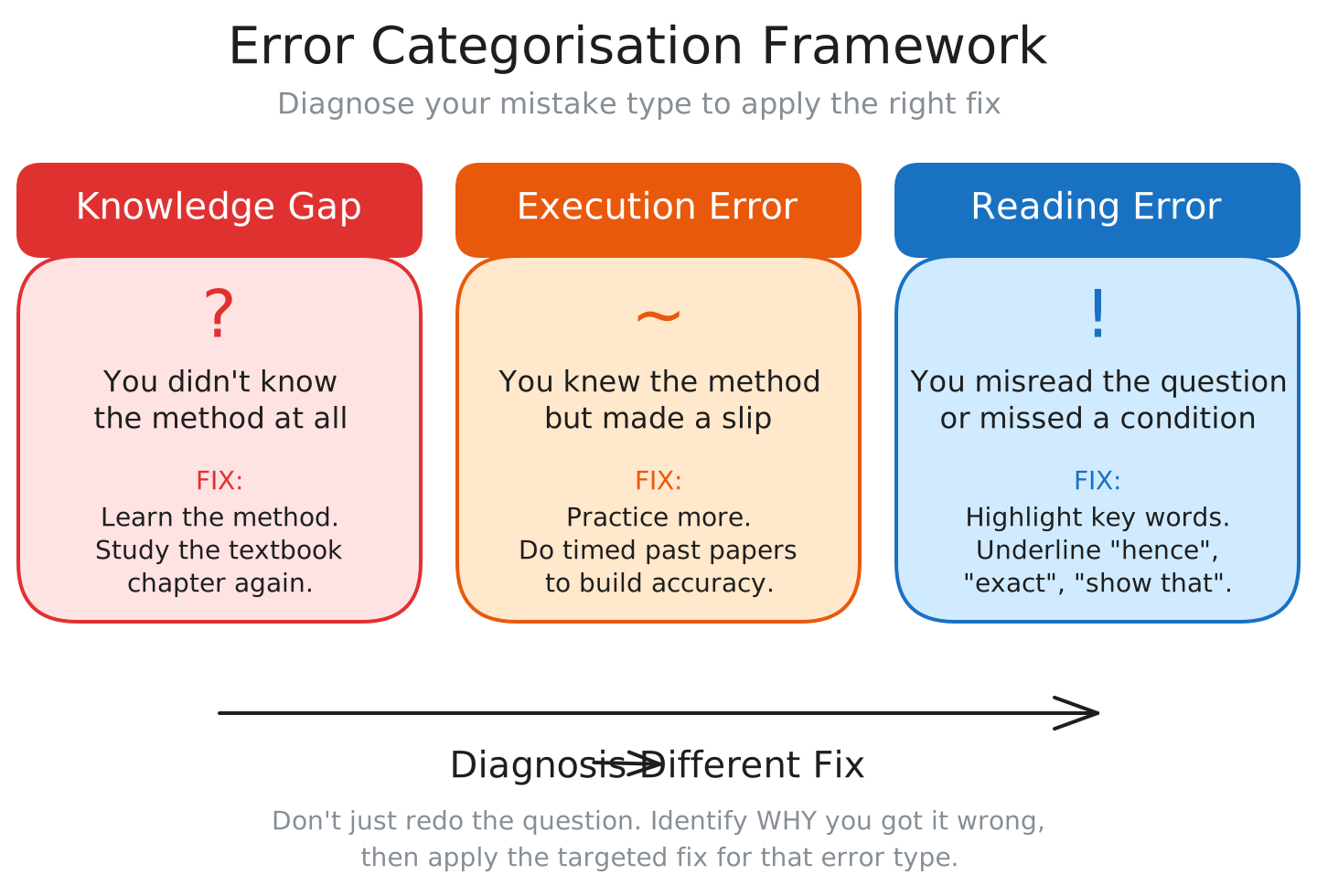
Review your error log before each practice paper. Over time, you will notice your recurring errors disappear as you become conscious of them. The log turns vague 'I need to be more careful' into specific, actionable fixes.
The Working Discipline
Clean, structured working is not just about earning method marks. It also reduces errors, because each line is simple enough to check. Build these habits: one algebraic step per line – do not combine two operations in one step. Label what you are doing – write 'differentiating:' or 'substituting x = 2:' before the step, which forces you to think about what you are doing rather than working on autopilot. Check by substitution – after solving for x, substitute your answer back into the original equation; after integrating, differentiate your answer to check it matches. The question to ask yourself: could someone follow your working without seeing the question? If the answer is no, your working is not detailed enough for the mark scheme.
How ExamPilot Helps
The mistakes in this article follow a pattern – students know the maths but lose marks on execution. That gap between understanding and accuracy is exactly what ExamPilot is built to close. The Exam Readiness Index tracks your accuracy by topic, showing you which areas have execution problems, not just knowledge gaps. If you keep losing accuracy marks on differentiation questions you can otherwise solve, the system flags it. Ask Sparky (coming soon) focuses on your reasoning process, not just the final answer – helping you build the working habits that earn method marks.
Ready to know exactly where you stand?
ExamPilot identifies your weak spots across all Pure 1 topics and targets them with adaptive practice.
By joining, you agree to receive emails from ExamPilot. Unsubscribe any time.
Reviewed by
Teresa González is co-founder of ExamPilot, an adaptive learning platform for Cambridge and Edexcel A-Level students. She holds Law and Marketing degrees from ICADE, and an MBA from ICEX-CECO, Spain's leading international trade institution.
Her career spans international trade and investment across Spain, Nigeria, and the United Kingdom. She subsequently became an entrepreneur and trading coach and educator at an internationally recognised trading education firm, before co-founding ExamPilot.
Her direct experience with A-Level preparation comes from supporting her children through the Edexcel and Cambridge examination systems. At ExamPilot, she leads educational content strategy, syllabus alignment, and quality review.
9709 Common Mistakes: What Cambridge Examiners Flag Every Session: frequently asked questions
Not showing working. Cambridge examiner reports repeatedly highlight insufficient working as one of the most widespread issues across recent sessions. Students who write only the final answer — even when it is correct — usually cannot earn method marks. On a question worth four marks, that can mean losing two or three marks for an answer that is technically right. The fix is straightforward: write every algebraic step on its own line.
Extremely. Cambridge produces examiner reports for 9709 papers after each session; these reports describe what students got wrong and why marks were lost. Your school can access them through Cambridge’s teacher support systems. Some reports and summaries are also available on public sites. They are written by the examiners who mark your papers and are extremely valuable for revision.
Cambridge International publishes recent examiner reports on their website. Some third‑party sites also host archived reports; search online by specification code ‘9709’ and session. Always check that materials are legal and up to date.
Based on examiner report commentary, students can easily lose around 10 marks or more per paper to execution errors – sign mistakes, missing constants of integration, premature rounding, and incomplete trigonometric solutions. On a 75-mark paper, that is enough to drop an entire grade. The distinction matters: if you knew the method but lost the mark, that is a fixable pattern.
Yes, a scientific calculator is permitted. However, you must still show all your working. The calculator can help you check answers, but if you write only a calculator result without the algebraic steps, you will usually not earn any method marks. Examiner reports repeatedly note that candidates who provide calculator-only answers forfeit significant marks.