9709 Coordinate Geometry (Pure 1): Notes & Questions
- Coordinate Geometry
- 9709 Coordinate Geometry covers straight lines, circles, and their intersections. Topic 1.3 of the Cambridge International AS & A Level Mathematics 9709 Pure 1 syllabus covers gradient, midpoint, and distance formulae, equations of lines in multiple forms, circle equations in standard and general form, tangents and normals, and intersection problems using the discriminant. Coordinate geometry is a regular feature of Paper 1, and tangent and normal questions may also involve differentiation.
ExamPilot maps your weak 9709 topics and drills them until they're not. Built for Cambridge 9709.
Practise coordinate geometry with adaptive questions calibrated to your level
Free during beta. No card needed.
We'll never share your email.
By joining, you agree to receive emails from ExamPilot. Unsubscribe any time.
Key takeaways
- 9709 Paper 1 coordinate geometry covers six syllabus sub-topics (1.3.1–1.3.6): gradient and midpoint, straight-line equations, parallel and perpendicular lines, circle equations, intersections, and tangents to circles.
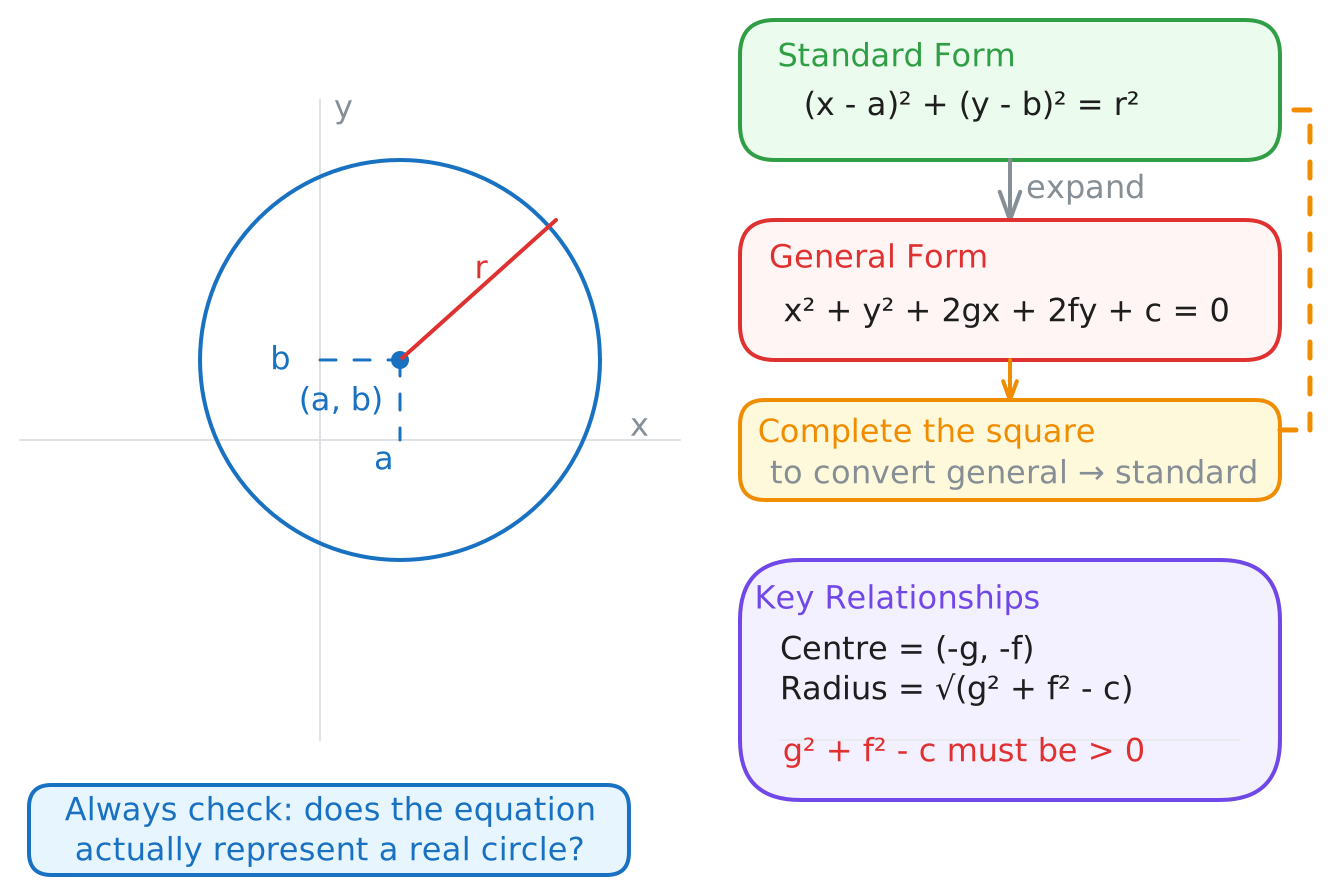
- The most common examiner-flagged error is sign mistakes in circle equations: the centre of x² + y² + 2gx + 2fy + c = 0 is (−g, −f), not (g, f).
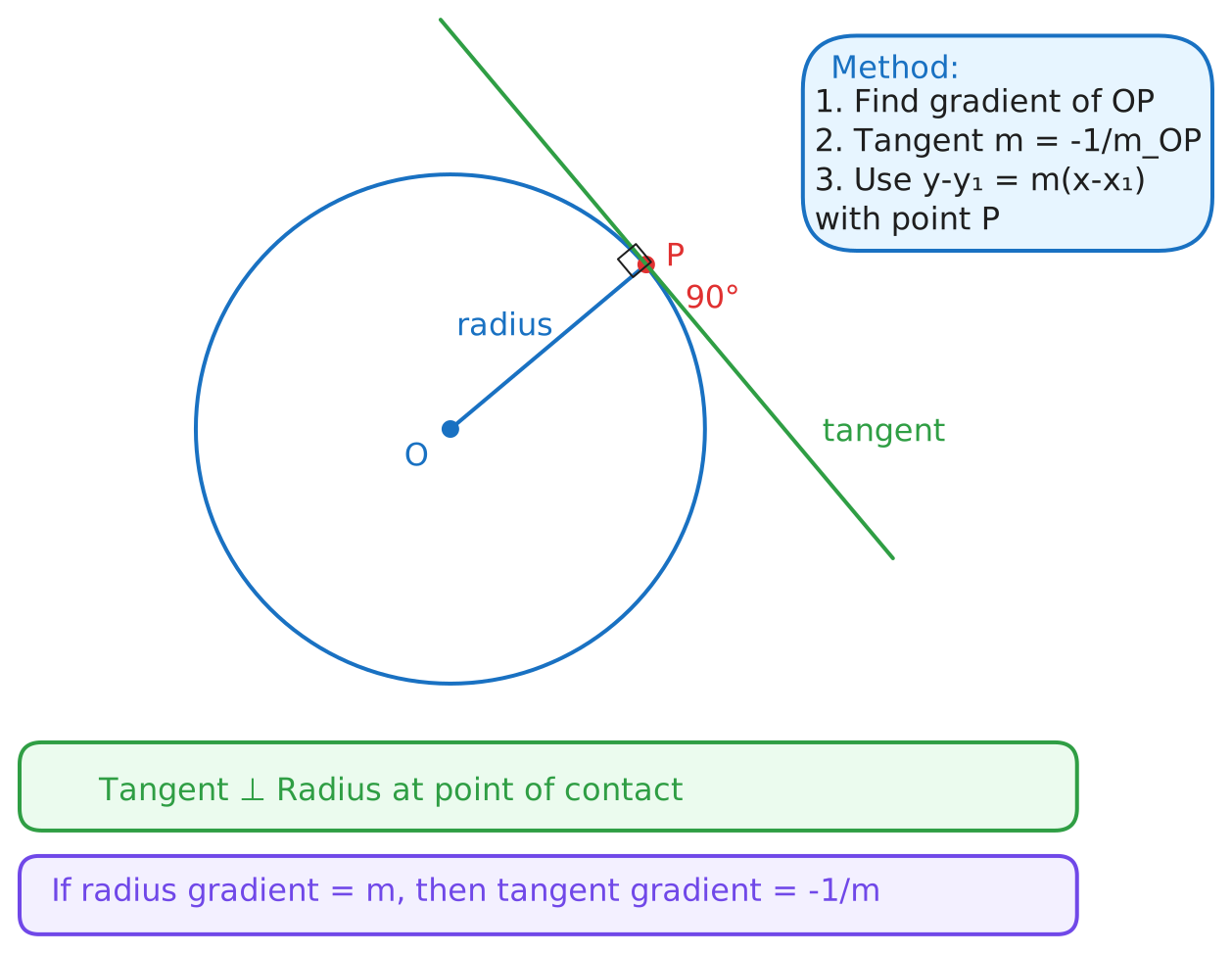
- Every tangent-to-a-circle question relies on one geometric fact: the tangent is perpendicular to the radius at the point of contact. Find the radius gradient, take the negative reciprocal.
- To show a line is a tangent algebraically, substitute it into the circle equation and confirm b² − 4ac = 0. One intersection point means tangent; two means the line cuts the circle.
This guide is part of our Complete Cambridge 9709 Pure 1 Revision Guide -- your comprehensive resource for exam preparation.
9709 Coordinate Geometry is a highly assessable topic on 9709 Paper 1. The question types are predictable, the methods are consistent, and students who know the system score full marks. The students who don’t? They often lose marks on sign errors in circle equations, forget the tangent‑radius relationship, or fail to sketch the diagram that would have shown them the answer.
This guide covers everything in Topic 1.3 of the Cambridge 9709 Pure Mathematics 1 syllabus, including the common mistakes that Cambridge examiners flag year after year. Whether you're sitting Paper 11, 12, or 13, the Pure Mathematics 1 coordinate geometry content is the same across all three variants.
What Cambridge 9709 Coordinate Geometry Covers
What's in scope for Paper 1
Topic 1.3 in the 9709 Pure 1 syllabus covers these coordinate geometry skills:
- 1.3.1 — Gradient, midpoint, and distance between two points
- 1.3.2 — Equation of a straight line: y - y1 = m(x - x1), y = mx + c, ax + by + c = 0
- 1.3.3 — Parallel and perpendicular line conditions
- 1.3.4 — Circle equation in standard and general form
- 1.3.5 — Intersection of lines and curves, including circles
- 1.3.6 — Tangents and normals to circles
What's not in Pure 1: parametric equations, polar coordinates, and loci problems beyond basic circles. This guide maps to Topic 1.3 of the Cambridge 9709 syllabus.
Understanding Circles Visually
The circle equation isn't just algebra — it describes a geometric shape. Every point (x, y) on the circle is exactly r units from the centre (a, b). That's what the equation (x - a)² + (y - b)² = r² says in mathematical language. Understanding this visual connection makes the algebra more intuitive.
The tangent-radius relationship is the foundation of almost every tangent question. A tangent touches the circle at exactly one point, and at that point, it makes a right angle with the radius. This geometric fact translates directly into the algebraic method: find the radius gradient, take the negative reciprocal, and you have the tangent gradient.
How Coordinate Geometry Connects to Other Topics
Finding tangents and normals to curves uses differentiation to get the gradient. Circle tangent questions use the radius method from this guide; curve tangent questions use dy/dx. See our 9709 Differentiation for the chain rule and gradient methods.
The discriminant condition (b² - 4ac) for intersection problems comes directly from quadratic theory. Most 'show the line is a tangent' question is a discriminant question in disguise. See our 9709 Quadratics for the full method.
Domain restrictions from circle and line constraints connect to the 9709 Functions topic. Understanding range and domain helps you check whether intersection solutions are valid.
What to Do Next
9709 Coordinate Geometry is the most predictable topic on the paper. The question types repeat, the methods are consistent, and the marks are there for the taking — if you avoid the traps that cost students 5-10 marks every session.
Master the three straight-line formulae. Get completing the square for circles right every time — especially the signs. Remember that a tangent is perpendicular to the radius, and use the discriminant to prove it algebraically. Draw the diagram. Show your working.
ExamPilot's adaptive practice identifies exactly which coordinate geometry sub-skills need work. If you keep making sign errors in circle equations, the system surfaces more completing-the-square questions until the habit is fixed. Smart Review resurfaces the formulae and methods at the intervals where forgetting is most likely.
Key formulas
Gradient
The gradient measures the steepness and direction of a line. A positive gradient means the line goes uphill from left to right. A negative gradient means downhill. A gradient of zero is a horizontal line, and an undefined gradient (division by zero) is a vertical line.
Midpoint and Distance
Leave the distance in surd form unless the question specifically asks for a decimal. When the answer is sqrt(52), simplify to 2sqrt(13) rather than reaching for the calculator. Exact form means exact form.
Equation of a Straight Line
Point-gradient form is your workhorse for exam questions. It handles any situation where you know the gradient and a point on the line. Only switch to y = mx + c when the question asks for the y-intercept or when you need to read off the gradient. The general form ax + by + c = 0 is useful when working with parallel and perpendicular conditions or when the question asks for integer coefficients.
Parallel and Perpendicular Lines
The perpendicular gradient is the negative reciprocal. If m = 3, the perpendicular gradient is -1/3. If m = −2/5, the perpendicular gradient is 5/2. Flip the fraction and change the sign.
Circle Equation
Converting between these two forms requires completing the square. The sign trap is the single most common coordinate geometry error: in the general form, the centre is (-g, -f), NOT (g, f). The sign in the bracket is the opposite of the coordinate. Write this out explicitly every time.
Worked examples
Finding the Equation of a Line
Perpendicular Bisector
Converting Circle Equation: General to Standard Form
Finding the Tangent to a Circle
Line-Circle Intersection (Show It's a Tangent)
Finding Area from Tangent and Axes
Combined Problem: Discriminant for Range of k
Common mistakes
Sign errors when completing the square for circle equations
The centre of x² + y² + 2gx + 2fy + c = 0 is (-g, -f), NOT (g, f). In the equation (x - 3)² + (y + 2)² = 25, the centre is (3, -2), not (3, 2). The sign in the bracket is the opposite of the coordinate. As the examiner report notes: 'Errors in the sign of the completed square form were common, particularly when the coefficient of x or y was negative.' (2023). Write the centre with explicit sign changes every time.
Forgetting the tangent-radius perpendicular relationship
The tangent gradient is the negative reciprocal of the radius gradient, not the radius gradient itself. Students find the radius gradient correctly but then use it directly as the tangent gradient. As the examiner report states: 'A significant number of candidates found the gradient of the radius but failed to use the perpendicular gradient for the tangent.' (2024). Always write 'perp = neg recip' in your working.
Not rearranging before reading the gradient
If the equation is 3x + 2y = 7, the gradient is NOT 3. You must rearrange to y = mx + c first: y = −3x/2 + 7/2, so the gradient is -3/2. As the examiner report notes: 'Candidates who did not rearrange the equation into the form y = mx + c before identifying the gradient frequently obtained incorrect values.' (2023). Always isolate y before reading off the gradient.
Rounding surds prematurely
When finding distances, leave the answer as sqrt(52) = 2sqrt(13) unless the question specifically says 'give your answer to 3 significant figures' or similar. Premature rounding loses accuracy marks. As examiners note: 'Candidates who converted exact values to decimals often lost the final accuracy mark.' (2024). If the question says 'exact form', it means surds.
Using the wrong discriminant condition
Tangent means b² - 4ac = 0 (one point of contact). Two intersections means b² - 4ac > 0. No intersection means b² - 4ac < 0. Students regularly use > 0 when the question asks for tangent (= 0). Know all three conditions as a set and match them to the exam phrasing: 'show the line is a tangent' always means discriminant = 0.
Exam tips
Which Coordinate Geometry Method Should You Use?
Cambridge 9709 Coordinate Geometry questions fall into four categories, and the method selection is more predictable than students realise. Identify the question type first, then apply the matching method. Don't start writing algebra until you know which path you're on.
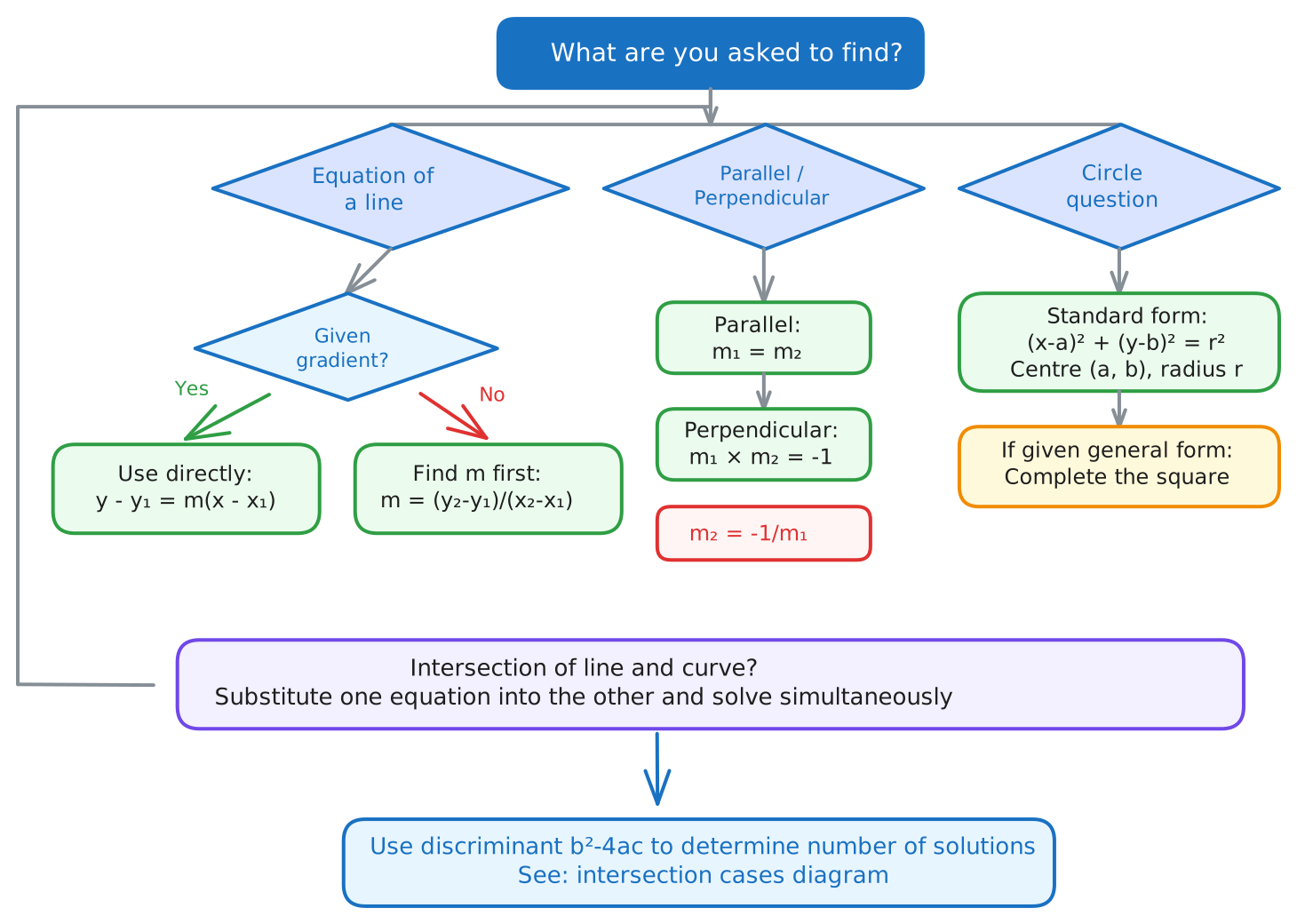
| Form | Use When | Example |
|---|---|---|
| y - y1 = m(x - x1) | You have a gradient and a point | Tangent at (3, 5) with gradient 2 |
| y = mx + c | You need the y-intercept or want slope-intercept form | Find where the line crosses the y-axis |
| ax + by + c = 0 | Working with perpendicular/parallel lines or integer coefficients needed | Rearrange to find gradient or compare lines |
The Discriminant in Coordinate Geometry
When a question asks you to find where a line meets a curve (or prove that it doesn't), you're in discriminant territory. Substitute the line equation into the curve equation, collect into a quadratic, and use the discriminant to determine the number of intersections. This is where coordinate geometry meets quadratics, and both skills must be solid.
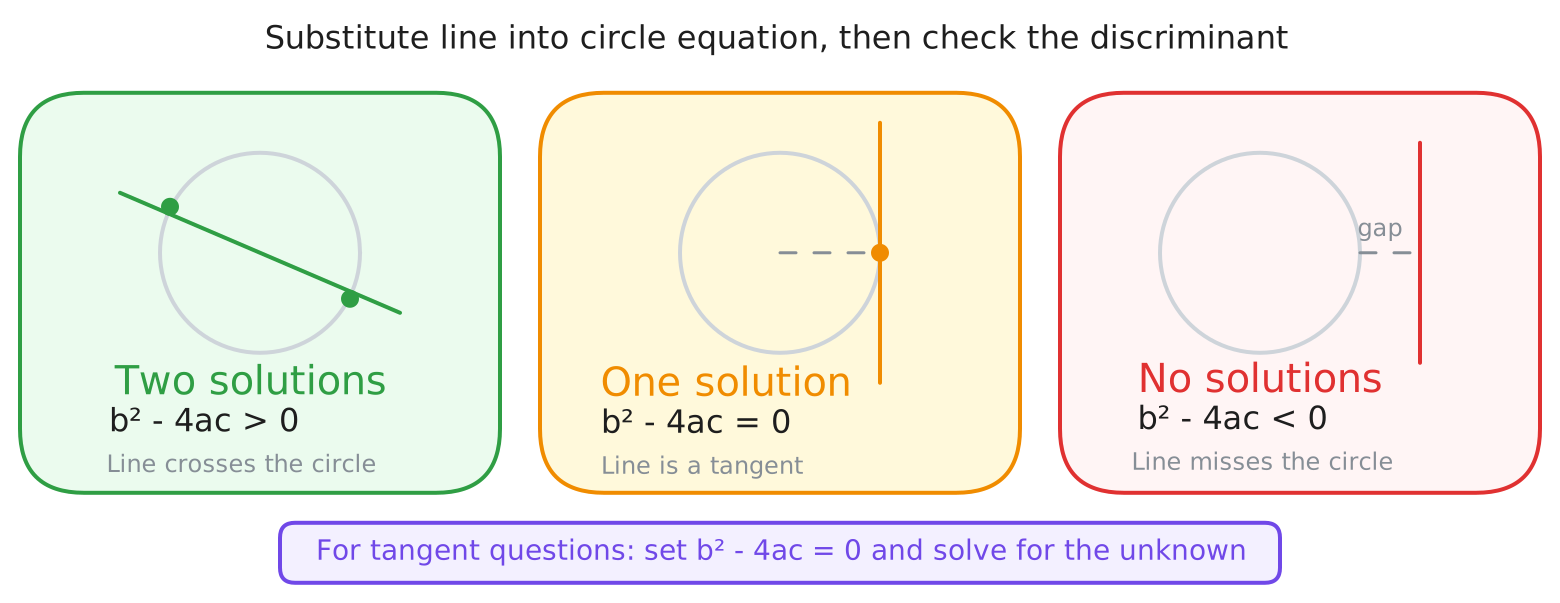
| Condition | Meaning | Exam Phrasing |
|---|---|---|
| b² - 4ac > 0 | Two distinct points of intersection | "Find the coordinates of the points where..." |
| b² - 4ac = 0 | Line is a tangent (one point of contact) | "Show that the line is a tangent to the curve" |
| b² - 4ac < 0 | No real intersection | "Show that the line does not meet the curve" |
Completing the Square for Circles
Converting from general form to standard form is the skill that determines whether you score full marks or lose them on circle questions. The method is mechanical: group the x terms and y terms, complete the square for each, and read off the centre and radius.
Revision Strategy for Coordinate Geometry
Stage 1 (two to three sessions): master the formulae. Gradient, midpoint, distance, line equations, circle equation in both forms. Practise converting between general and standard form until completing the square for circles is automatic. Get the signs right every time.
Stage 2 (three to four sessions): practise the set-piece questions. Tangent to a circle, perpendicular bisector, line-curve intersection with discriminant. These question types repeat every session. Work through past paper examples sorted by type until the method selection is instinctive.
Stage 3 (ongoing): timed mixed practice. Combine all sub-topics under exam conditions. Real 9709 questions mix straight-line work with circles and intersection problems in a single multi-part question worth 8-10 marks.
Frequently asked questions
Practise 9709 Coordinate Geometry with adaptive questions calibrated to your level
ExamPilot identifies your weak spots and targets them with adaptive, exam-specific practice.
No spam — just your invite.
By joining, you agree to receive emails from ExamPilot. Unsubscribe any time.