9709 Circular Measure (Pure 1): Radians & Questions
- Circular Measure
- 9709 Circular Measure covers radians, arc length, and sector area. Topic 1.4 of the Cambridge International AS & A Level Mathematics 9709 (Pure 1) syllabus tests radian-degree conversion, the arc length formula s = rθ, sector area A = ½r²θ, and combined problems involving segment area and composite-shape perimeters. Circular measure is a small but regular part of Paper 1, often appearing as one structured question or as part of a longer problem.
ExamPilot maps your weak 9709 topics and drills them until they're not. Built for Cambridge 9709.
Practise circular measure with adaptive questions calibrated to your level
Free spot in our invite-only Closed Beta. Cambridge 9709 exams are in Oct/Nov. Get on the list now.
We'll never share your email.
By joining, you agree to receive emails from ExamPilot. Unsubscribe any time.
Key takeaways
- Circular measure in Cambridge 9709 Pure 1 covers radians, arc length, sector area, and segment problems — Topic 1.4, examined in Paper 1.
- The most common examiner error is confusing the perimeter of a segment: it requires the arc plus the chord, not the arc alone — a single-step omission that costs marks.
- The core formulas s = rθ and A = ½r²θ only work when θ is in radians. Using degree mode produces answers off by a factor of ~57.
- ExamPilot's adaptive practice identifies whether you're making the degree/radian or perimeter error and targets that gap with spaced-repetition questions.
This guide is part of our Complete Cambridge 9709 Pure 1 Revision Guide — your comprehensive resource for exam preparation.
Understanding Circular Measure in Cambridge 9709
What Circular Measure Covers in 9709 Pure 1
Circular measure is a core topic in the Cambridge International AS & A Level Mathematics 9709 programme, examined in Paper 1 (Pure Mathematics 1).
If degrees work perfectly well for measuring angles, why does A-Level Maths introduce a completely different unit? One reason: the formulae. Arc length is s = rθ. Sector area is A = (1/2)r²θ. Both are clean, compact, and exact — but only when θ is measured in radians. Use degrees and neither formula works without an ugly correction factor. That single fact is the entire motivation behind radian measure.
- Circular measure in 9709 Paper 1 tests three formulas: arc length s = rθ, sector area A = ½r²θ, and segment area A = ½r²(θ − sin θ). All three require the angle to be in radians.
- The most common examiner-reported mistake is giving arc length alone as the perimeter of a segment. The correct perimeter = arc + chord, where chord = 2r sin(θ/2).
- Circular measure questions in Cambridge 9709 follow a predictable pattern: a diagram, two or three sub-parts, and the same four techniques every time. Once you know the method, every mark is within reach.
- Always check your calculator is in radian mode before starting. Degree mode produces answers wrong by a factor of ~57 (180/π) — the most avoidable error in this topic.
What's in scope for Paper 1
- 1.4.1 — Radian measure: definition, conversion between degrees and radians
- 1.4.2 — Arc length: s = rθ
- 1.4.3 — Sector area: A = ½r²θ
- 1.4.4 — Problems involving arc length, sector area, and segment area in composite shapes
That’s it. There are no polar coordinates, no parametric curves, and no arc length for general functions in Paper 1. The topic is focused and relies on a small number of core formulae, so the marks are there for students who prepare properly.
Radians: The Unit That Makes the Formulae Work
A radian is the angle subtended at the centre of a circle by an arc whose length equals the radius. Wrap the radius along the circumference and the angle you've swept is exactly one radian. Since the full circumference is 2πr, there are 2π radians in a full turn — giving the fundamental relationship: π radians = 180°.
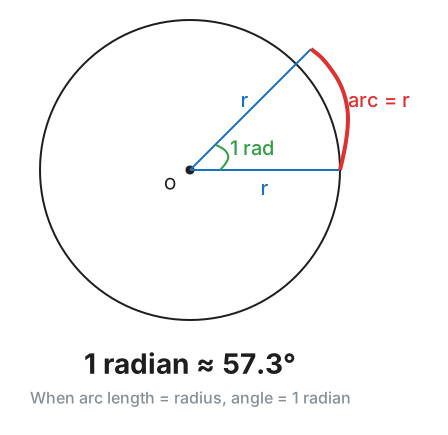
The key radian values appear constantly in 9709 questions and connect directly to the exact values used in trigonometry: 30° = π/6, 45° = π/4, 60° = π/3, 90° = π/2, 180° = π, 360° = 2π. If you derived these from the two special triangles in the 9709 Trigonometry, you already know them. The radian column in the exact values table is the same set of angles.
Sector, Segment, and Triangle: The Three Regions
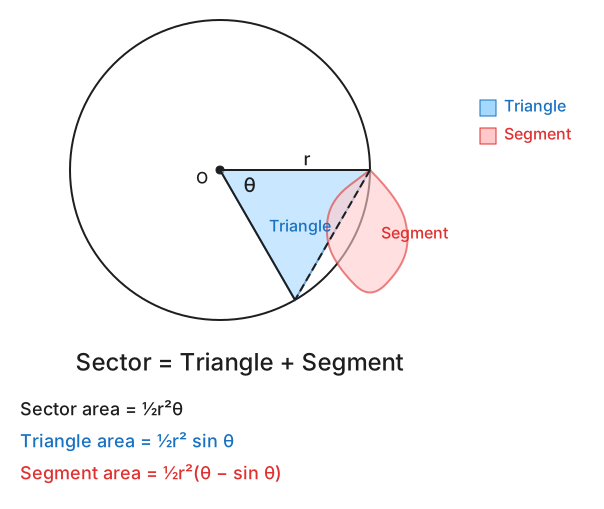
This is where Cambridge 9709 circular measure questions start separating students who understand the geometry from those who memorised without thinking. A sector is a 'pizza slice' — the region between two radii and the arc. A segment is the region between a chord and the arc. The relationship: segment area = sector area minus triangle area.
The Perimeter Trap
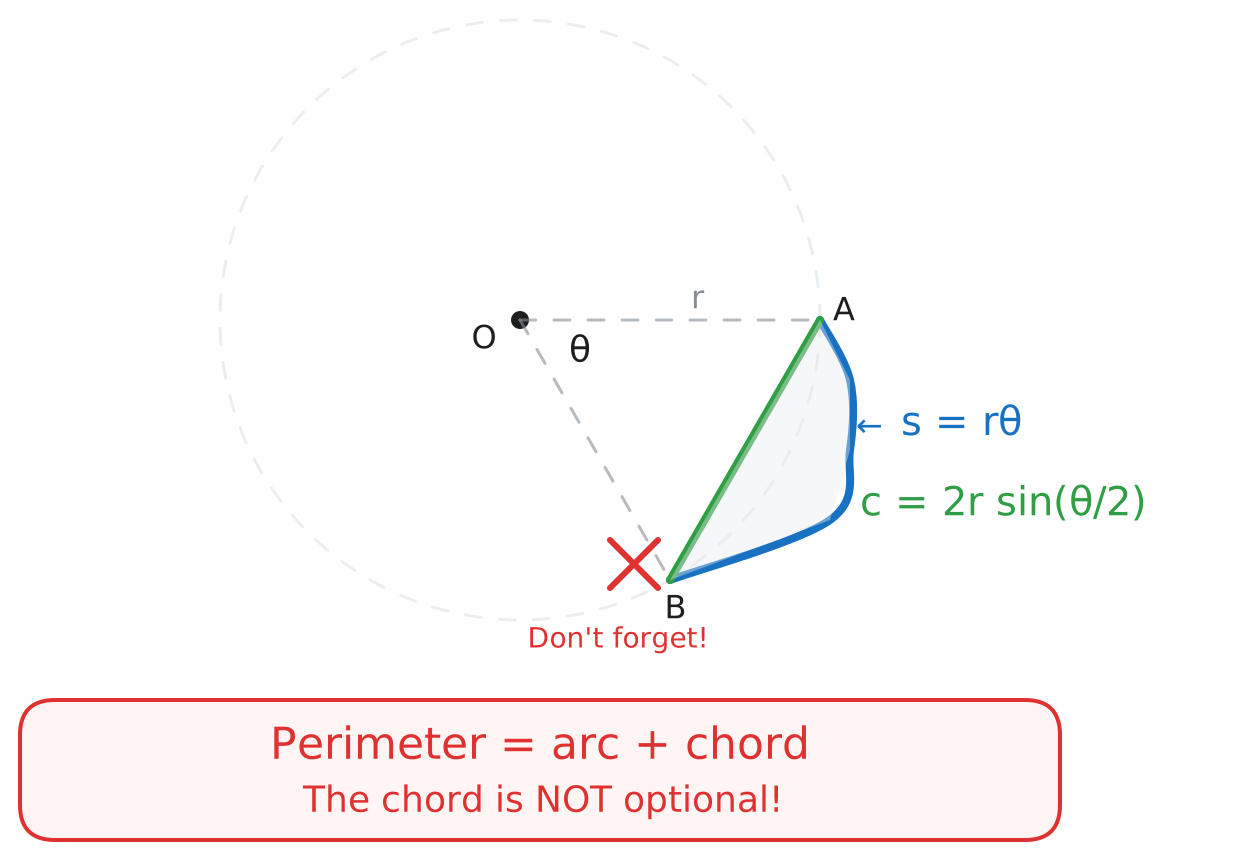
This is the single most common error in 9709 circular measure. The perimeter of a circular segment is the sum of the arc length and the chord length — not just the arc. The chord length is 2r sin(θ/2). If a question asks for the perimeter of a region bounded by an arc and a chord, you need both pieces. Students who draw the shape and list every boundary edge before calculating consistently avoid this mistake.
Composite Shape Problems
The harder circular measure questions on Paper 1 combine sectors, segments, triangles, and sometimes rectangles into a single figure. The approach is always the same: (1) draw and label the diagram — mark every radius, angle, arc, and chord; (2) identify each component shape; (3) calculate each piece separately using the appropriate formula; (4) combine with addition or subtraction — for area, add or subtract depending on the region, and for perimeter, add all boundary lengths.
How 9709 Circular Measure Connects to Trigonometry
Radians are used throughout trigonometry — the exact values (sin π/6, cos π/4, etc.) are given in radians. See our 9709 Trigonometry for the full exact values table and identities.
The triangle area formula A = (1/2)r² sin θ also appears in non-right-angle triangle problems. Fluency with this formula in circular measure transfers directly to trigonometry questions. Once you're confident with circular measure, move on to 9709 Integration — another topic where the formulae are few but the application requires practice.
Circular Measure Formula Summary for Cambridge 9709 Pure 1
Cambridge 9709 circular measure is the smallest topic on Pure 1 by mark weight, but every mark lost here is preventable. The formulae are few: s = rθ for arc length, A = (1/2)r²θ for sector area, and (1/2)r²(θ − sin θ) for segment area. The perimeter of a segment is arc plus chord, not arc alone. Always check your calculator is in the correct angle mode. Draw the diagram. Subtract the triangle for segment problems. These three habits cover every common mistake in the examiner reports.
What to Do Next: Practise Circular Measure on ExamPilot
Circular measure questions follow a predictable pattern. Once you can convert degrees to radians confidently and apply the arc length and sector area formulae, this topic becomes one of the most reliable sources of marks on Paper 1. ExamPilot's adaptive practice builds calculator-mode awareness into your sessions and targets the specific sub-skills you need work on.
Ready to practise circular measure with questions calibrated to your level? Join the ExamPilot waitlist for adaptive A-Level Maths practice.
Revising other Pure 1 topics? See our 9709 Binomial Series, our 9709 Integration, our 9709 Differentiation or our 9709 Quadratics.
Key formulas
Radian-Degree Conversion
These key radian values appear constantly in 9709 questions and connect directly to the exact values used in trigonometry: 30° = π/6, 45° = π/4, 60° = π/3, 90° = π/2, 180° = π, 360° = 2π. If you derived these from the two special triangles in the trigonometry guide, you already know them.
Arc Length
The arc length formula is the reason radians exist. When θ is in radians, arc length is simply radius times angle. If you tried to use degrees instead, the formula would become s = πrθ/180 — functional, but messy. In radians, it's as clean as it gets.
Sector Area
A full circle has area πr² and subtends 2π radians. A sector subtending θ radians is the fraction θ/(2π) of the full circle: A = θ/(2π) × πr² = (1/2)r²θ. This derivation makes the formula obvious rather than something to memorise.
Triangle Area (Two Radii and Included Angle)
This is the standard triangle area formula (1/2)ab sin C with both sides equal to the radius r and the included angle θ. You need this to subtract from the sector area when finding a segment.
Segment Area
Segment = sector minus triangle. Factor out (1/2)r² to get the clean form: (1/2)r²(θ − sin θ). This formula is not given on the formula sheet — derive it from the sector and triangle formulae above and it becomes obvious rather than something to memorise.
Chord Length
The chord connects the two endpoints of the arc. You need this for segment perimeter calculations — the perimeter is arc length plus chord length, not arc alone.
Worked examples
Converting Degrees to Radians
Finding Arc Length
Finding Sector Area
Finding the Area of a Segment
Perimeter of a Segment
Composite Shape: Shaded Region Area
Common mistakes
Giving arc length alone as the perimeter of a segment
The perimeter of a segment is arc + chord, not just the arc. The chord length is 2r sin(θ/2). As Cambridge examiners note: "A significant number of candidates found the arc length correctly but then omitted the chord when calculating the perimeter, losing the final 2-3 marks." Always draw the shape and label every boundary before calculating.
Using degrees in a formula that requires radians
The formulae s = rθ and A = (1/2)r²θ only work when θ is in radians. If you substitute degrees, your answer will be wrong by a factor involving π/180. If the question gives the angle in degrees, convert to radians before substituting. Also check your calculator mode — using degree mode when the question works in radians changes trig values by a factor of about 57 (since 180 / π ≈ 57.3 180/π≈57.3)
Confusing sector, segment, and triangle
A sector is the 'pizza slice' between two radii and the arc. A segment is the region between a chord and the arc. The triangle is formed by the two radii and the chord. Segment area = sector area minus triangle area. Students who draw the diagram almost never make this mistake. Students who attempt the problem purely algebraically often do.
Not drawing a diagram for composite-shape problems
Circular measure problems are inherently geometric. Without a diagram, students miss boundaries, double-count areas, or apply the wrong formula. Spend 30 seconds sketching the shape before you calculate anything. Label every radius, angle, arc, and chord. The sketch often reveals the approach immediately. Examiner reports consistently note that students who draw diagrams score higher on these questions.
Forgetting to subtract the triangle for segment area
Segment = sector minus triangle. Not sector alone. The segment area formula is (1/2)r²(θ − sin θ), which is the sector area (1/2)r²θ minus the triangle area (1/2)r² sin θ. If you draw the diagram, the subtraction is visually obvious — the segment is what remains after removing the triangle from the sector.
Exam tips
Sector, Segment, or Triangle? Know What You're Calculating
The three regions inside a circle cause constant confusion. A sector is bounded by two radii and an arc — shaped like a pizza slice. A segment is bounded by a chord and the arc. The triangle is bounded by two radii and the chord. The key relationship: segment = sector minus triangle. Draw the diagram first and the geometry makes the formula obvious — you can see the segment is the sector minus the triangle.
| Shape/Measurement | Formula | Key Note |
|---|---|---|
| Arc length | s = rθ | Curved distance along the circumference |
| Sector area | A = ½r²θ | The 'pizza slice' region |
| Triangle area (in sector) | A = ½r² sin θ | Formed by the two radii and the chord |
| Segment area | A = ½r²(θ − sin θ) | Sector minus triangle |
| Chord length | c = 2r sin(θ/2) | Straight line between arc endpoints |
Verifying a Perimeter Calculation
When a question asks for the perimeter of a region, list every boundary piece before computing. For a segment: arc + chord. For a composite shape: identify each straight edge and each curved edge separately. Tick off each piece as you calculate it. A common examiner comment is that students find most of the pieces correctly but miss one edge — usually the chord in a segment problem or a straight line in a composite shape.
Degrees vs Radians: The Calculator Trap
Before every circular measure calculation, check your calculator mode. If the question works in radians (almost all circular measure questions do), your calculator must be in radian mode. Getting the mode wrong produces answers that are completely off — typically by a factor of about 57, which is 180/π. This is a common examiner-reported error.
Revision Strategy for 9709 Circular Measure
Stage 1 — Learn the conversions (Day 1). Practise converting between degrees and radians until it's automatic. Know the standard values (30°, 45°, 60°, 90°, 180°, 360°) without thinking. These connect directly to the exact trig values from the trigonometry guide.
Stage 2 — Master the formulae (Days 2-3). Work through five to eight questions on each sub-topic in this order: arc length calculations, sector area calculations, segment area (sector minus triangle), perimeter problems (arc plus chord plus any straight edges), composite shapes. If you're getting more than one in four wrong on any sub-topic, stay there until the errors stop.
Stage 3 — Exam simulation (Days 4+). Practise full circular measure questions under timed conditions. The question pattern is predictable: a diagram with a sector, a calculation, then a perimeter or segment problem. Once you've seen five of these questions, you've seen the pattern.
Frequently asked questions
Practise 9709 Circular Measure with adaptive questions calibrated to your level
ExamPilot identifies your weak spots and targets them with adaptive, exam-specific practice.
No spam — just your invite.
By joining, you agree to receive emails from ExamPilot. Unsubscribe any time.