
What 5 Years of Cambridge 9709 Examiner Reports Reveal About Pure 1
Five years of Cambridge 9709 examiner reports say the same thing, session after session: students who lose marks in Pure 1 usually understood the maths. Not showing working, mixing radians and degrees, forgetting to square before a volume of revolution, giving one trig solution when the question wanted three — the same handful of errors recur across Papers 11, 12 and 13, year after year, and almost all of them are fixable in the way you write, not what you know.
That's the uncomfortable, hopeful truth buried in every Cambridge examiner report. The students losing marks usually understood the maths. They lost the marks on execution.
Consider Maya, sitting Paper 12 in a hot exam hall in May. She solves a quadratic in her head, types it into her calculator, writes down x = 3 and x = -2, and moves on. Correct answers. Zero method marks. The examiner report for that session says it plainly: a correct answer with no working is "not acceptable." Maya didn't fail to do the maths. She failed to show it.
This article walks through what the Cambridge AS & A Level Mathematics (9709) examiner reports actually say about Pure 1 (Papers 9709/11, 9709/12 and 9709/13), the specific mistakes that recur year after year, and the small changes that stop them. You won't find vague advice here. Every pattern below comes straight from the examiners' own words.
Key takeaways
- The single most repeated message in every 9709 Pure 1 examiner report is the same: unsupported answers from a calculator earn no marks, even when correct.
- Circular measure is the most consistent weak spot in Pure 1, and the most common errors (radians vs degrees, perimeter vs area) are avoidable.
- In integration, the marks most often lost come from forgetting to square y in a volume of revolution and dropping the constant of integration.
- In trigonometry, students routinely find one solution when the question has two or three. The technique is fine; the range is the problem.
- Most lost marks in Pure 1 are execution habits, not knowledge gaps, which means they are fixable fast.
What do Cambridge 9709 examiner reports actually tell you?
A Cambridge 9709 examiner report is the principal examiner's written summary of how candidates performed on each paper, question by question, after every exam session. It tells you exactly where students went wrong, in the examiner's own words, and it's published openly for Cambridge International AS & A Level Mathematics (9709).
Most students never read them. That's the opportunity. While everyone else grinds past papers, the examiner reports tell you in advance which mistakes the examiners are tired of seeing, which means they're the mistakes most likely to cost you marks.
Reading five years of these reports for Pure 1 (March 2020 through to the 2024 sittings) reveals something striking. The errors are remarkably stable. The same six or seven habits appear across Papers 11, 12 and 13, across summer and winter sittings, year after year. That consistency is good news: it means a short, targeted list protects you against most avoidable loss.
Curious how ExamPilot turns examiner-report patterns into a revision plan that targets your actual weak topics? See how it works →.
The most common 9709 Pure 1 mistakes at a glance
- All topics: an answer written with no working ('unsupported') — fix: show factorisation, the formula with values substituted, or completing the square
- Circular measure: mixing radians and degrees, or finding area instead of perimeter — fix: work in radians throughout, underline what's asked before you compute anything
- Integration: forgetting to square y, or dropping the '+ c' — fix: write 'V = pi times the integral of y squared dx' and '+ c' before you start
- Trigonometry: giving one solution when two or three exist — fix: sketch the range and mark every solution first
- Differentiation: not realising you need to differentiate — fix: spot trigger words like 'rate of change' and 'how fast'
Want the complete topic-by-topic checklist with a fix for all ten recurring 9709 errors? See our 9709 Common Mistakes guide. That article goes deeper into what the underlying examiner reports actually say, session by session.
The most common mistake in Cambridge 9709 Pure 1: unsupported answers
The most common mistake in Cambridge 9709 Pure 1 is giving an answer with no method shown. Examiners cannot award method marks for working they cannot see, and they explicitly will not give credit for an answer that appears to come straight off a calculator, even when that answer is right.
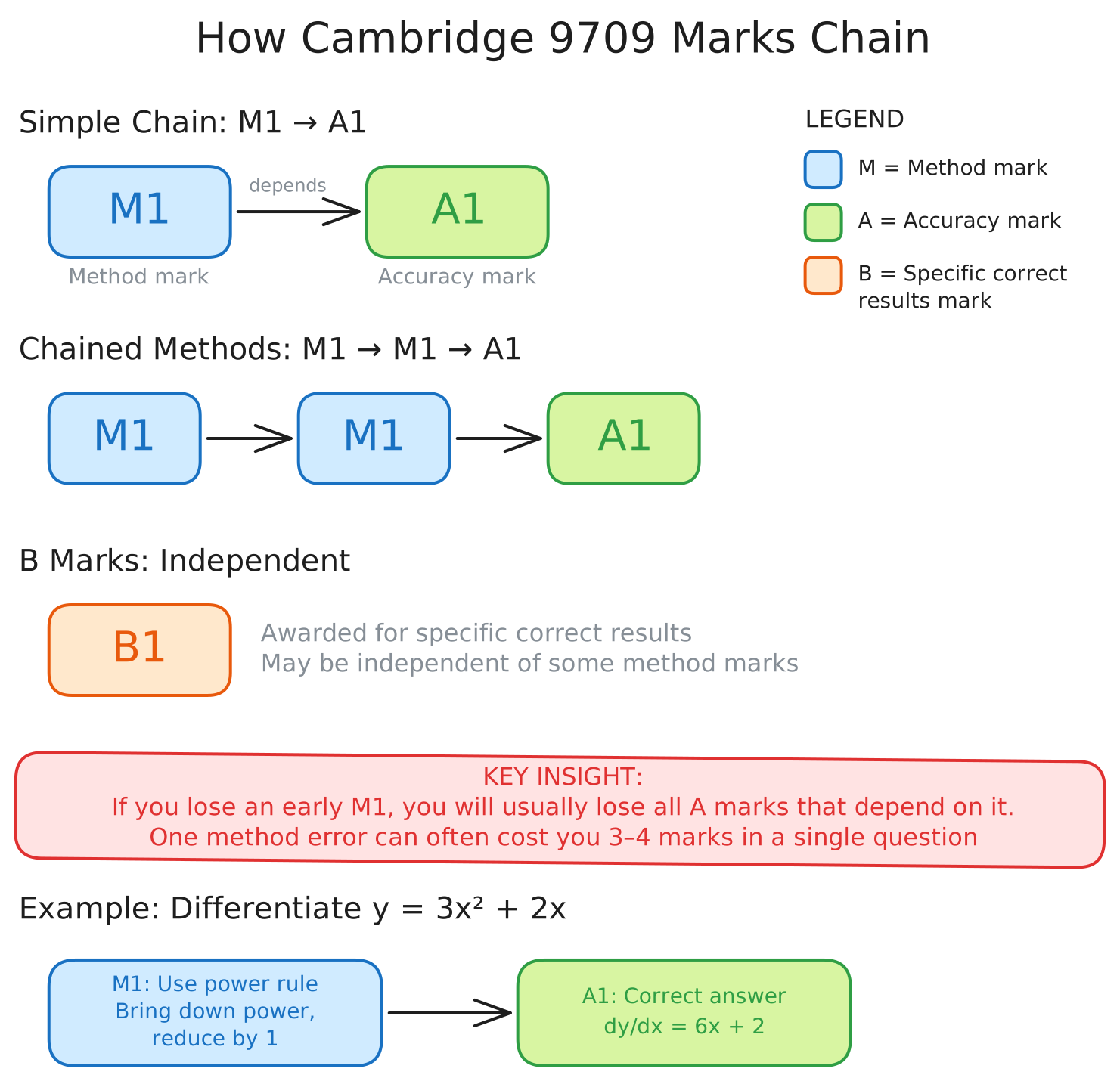
This is the spine of every report. The rubric reminder appears almost word for word across sessions:
It goes further than quadratics. One report spells out the full list of where unsupported answers fail:
And quoting a formula is not the same as using it:
How to fix it: for every quadratic, show factorisation, the formula with numbers substituted in, or completing the square. For definite integrals, write the limits substituted into the expression before you reach for the calculator. Treat the calculator as a checker, not a worker. The habit costs you ten seconds per question and protects marks on almost every question in the paper.
Why do students lose marks on circular measure in 9709 Paper 1?
Students lose marks on circular measure mainly by mixing radians and degrees, and by calculating an area when the question asked for a perimeter (or the reverse). Circular measure is the single most consistent weak spot in Pure 1 across every year reviewed, and almost every error in it is avoidable.
The radian-versus-degree problem is so common that examiners flag it bluntly:
The second pattern is reading speed. Students find one quantity and stop, missing that the question wanted two:
A third recurring trap is the triangle inside the sector. Reports note students assuming a triangle is right-angled when it is not, or calculating half the triangle's area instead of the whole. The fix for all three is the same discipline: work in radians from start to finish, and underline exactly what the question asks for before you compute anything.
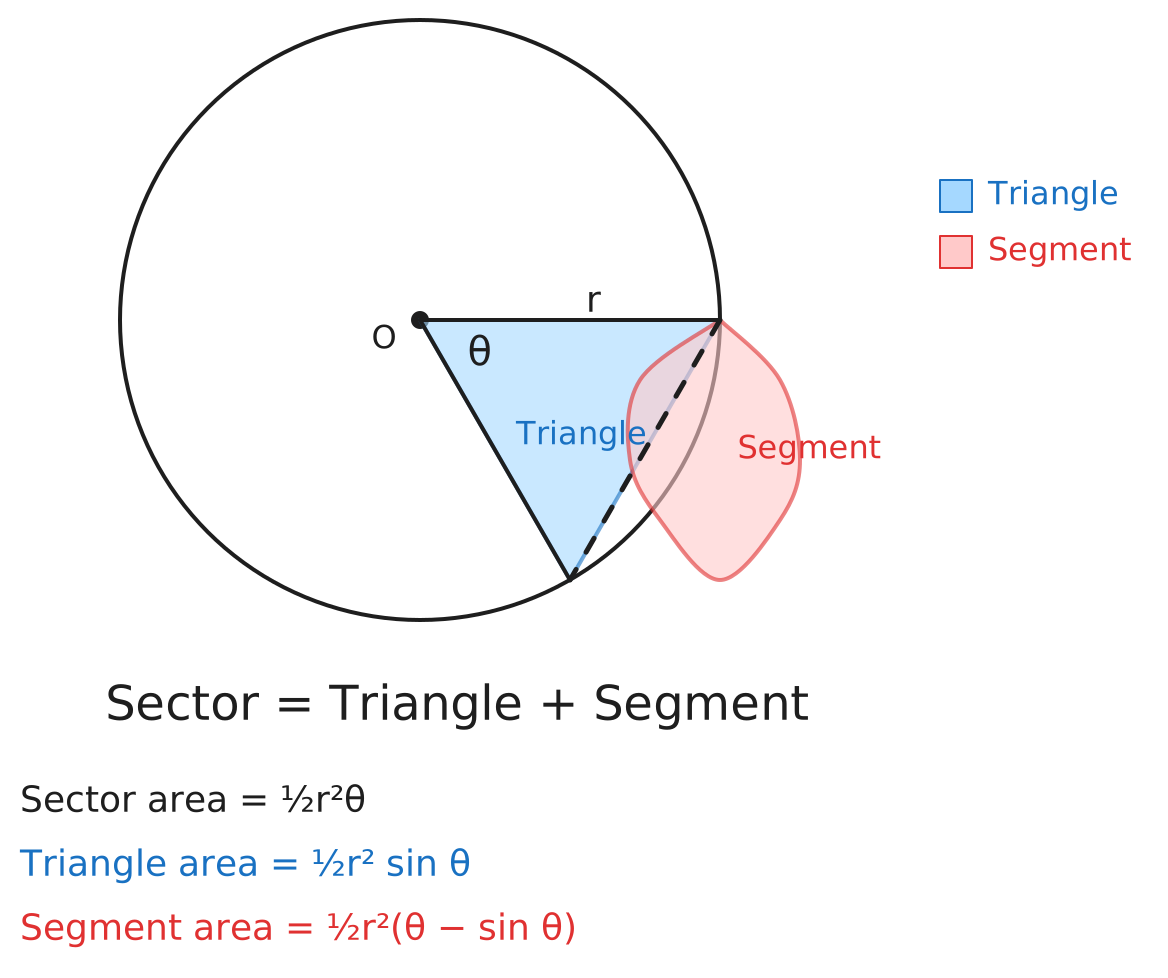
Circular measure rewards the student who slows down for ten seconds at the start. Our guide to circular measure in 9709 Pure 1 covers the full method, including the segment-versus-sector distinction examiners keep flagging.
What integration mistakes cost marks in 9709 Pure 1?
In integration, the two most expensive Pure 1 mistakes are forgetting to square y when finding a volume of revolution, and dropping the constant of integration when finding the equation of a curve. Both are mechanical, and both are flagged year after year.
The volume of revolution error is almost a signature of the topic. Students set up the integral but skip the squaring step, and the report describes exactly what happens next:
A close cousin is computing the wrong thing entirely, area instead of volume:
When the question runs the other way, from gradient to curve, the lost mark is the constant. Students integrate correctly, then forget the '+ c', and the final marks go with it.
How to fix it: before integrating for a volume, write 'V = pi times the integral of y squared dx' at the top of your working so the square is locked in. When integrating to find a curve, write '+ c' immediately, before you even simplify, then use the given point to find it. Make the easy-to-forget step the first thing you write. Our 9709 Pure 1 integration guide covers the full method on both.
Most students do not know which topics quietly leak marks until results day.
Ready to find your actual weak spots before the exam?
Free — no card required
By joining, you agree to receive emails from ExamPilot. Unsubscribe any time.
How do students lose marks on trigonometry in 9709 Pure 1?
In trigonometry, students lose marks most often by finding only one solution when the question has two or three within the range. The algebra and the identities are usually handled well. The marks leak from incomplete solution sets and from clumsy fraction work, not from misunderstanding.
The pattern is everywhere in the reports. A student solves correctly, finds the first-quadrant angle, and stops:
A related error is carrying an invalid value forward instead of discarding it, which can sink a whole part:
There is also a quieter, more fundamental issue examiners return to: combining algebraic fractions. One report calls clean fraction work 'a fundamental skill which candidates would benefit from practising more extensively.'
How to fix it: when you solve a trig equation, sketch the curve or the CAST diagram for the given range and mark every solution before you write any down. Make finding all the solutions a separate, deliberate step, not an afterthought. Our 9709 Pure 1 trigonometry guide walks through finding every solution in range.
A common 9709 Pure 1 differentiation mistake: not knowing when to differentiate
Most students who attempt rates-of-change questions lose full marks simply by not recognising that differentiation is required. They substitute a value straight into the original formula instead of differentiating first, and the question scores nothing.
This is one of the few errors that is a genuine recognition failure rather than a slip, and the examiners notice how rarely the right move appears:
The second differentiation trap is in 'show that it is always increasing' questions. Students test a few values, see positive numbers, and conclude the gradient is always positive. The report is firm that this is not a proof:
How to fix it: train yourself to spot the trigger words. 'Rate of change', 'how fast', 'per second' all mean differentiate, usually with the chain rule. To show a function is always increasing, show the derivative cannot be negative using algebra (a square is non-negative, a positive over a positive is positive), never a handful of test values.
What is the one habit that protects the most marks across all of Pure 1?
The single highest-value habit in Cambridge 9709 Pure 1 is showing complete, readable working, because it protects method marks on every topic at once. After that comes maintaining accuracy: examiners repeatedly dock marks for premature rounding and for answers given to too few significant figures.
Three cross-cutting habits appear in every report, regardless of topic:
- Show every step. Method marks are awarded for visible reasoning, not silent correctness. This is the calculator rule from the first mistake, applied everywhere.
- Hold your accuracy. Work to at least four significant figures in the middle of a calculation when the final answer needs three, and never round an angle early in a circular-measure question.
- Read the whole question, and draw the diagram. Examiners explicitly recommend sketches, especially for circle and coordinate geometry questions.
There is a wider point here about how to revise. Grinding past papers tells you whether you got a question right. The examiner reports tell you why students get it wrong, which is the part that actually changes your score. You improve fastest when you practise the habit, not just the topic.
Instead of handing you another stack of PDFs, ExamPilot maps which 9709 Pure 1 topics are leaking your marks and builds a revision plan around active recall and spaced repetition, so the fix sticks. You can explore the full topic breakdown in our Cambridge 9709 Pure 1 revision guide.
The bottom line on 9709 Pure 1 mistakes
The Cambridge 9709 examiner reports deliver the same verdict every year: most lost marks in Pure 1 come from execution, not understanding. Students who know the maths still lose marks by not showing working, mixing radians and degrees, forgetting to square y, dropping a constant, or stopping at one trig solution. None of these are knowledge gaps. They are habits, and habits can be changed in a single focused revision session.
Your next step is simple. Pull the most recent 9709 examiner reports for Papers 12 and 13, read the Pure 1 comments, and turn the recurring mistakes into a personal checklist you run on every practice question: working shown, units consistent, accuracy held, question fully answered. Do that, and you stop donating marks you have already earned.
You know the maths. Now make sure the examiner can see it.
Ready to find your actual weak spots?
Free — no card required
By joining, you agree to receive emails from ExamPilot. Unsubscribe any time.
Frequently Asked Questions
Reviewed by
Teresa González is co-founder of ExamPilot, an adaptive learning platform for Cambridge and Edexcel A-Level students. She holds Law and Marketing degrees from ICADE, and an MBA from ICEX-CECO, Spain's leading international trade institution.
Her career spans international trade and investment across Spain, Nigeria, and the United Kingdom. She subsequently became an entrepreneur and trading coach and educator at an internationally recognised trading education firm, before co-founding ExamPilot.
Her direct experience with A-Level preparation comes from supporting her children through the Edexcel and Cambridge examination systems. At ExamPilot, she leads educational content strategy, syllabus alignment, and quality review.