How to Pass Cambridge 9709: The Complete Exam Strategy Guide
How Cambridge 9709 Works (The Structure)
Cambridge 9709 is the course code for Cambridge International A-Level Mathematics. If you're sitting this, you're studying maths at the highest pre-university level — and it's split across two years.
Year 12 — AS Level (2 papers)
In your first year, you sit two papers worth 150 marks in total. Every student sits Paper 1 (Pure Mathematics 1). For your second paper, you choose one of the following:
- Paper 2 (Pure Mathematics 2) — if your school is doing a pure-only AS Level. Note: this route does not lead to the full A-Level.
- Paper 4 (Mechanics) — motion, forces, and vectors applied to maths.
- Paper 5 (Probability & Statistics 1) — data, probability, and statistical reasoning.
Your school will usually make this choice for you based on their timetable. If you're unsure which one you're doing, check with your teacher.
Year 13 — completing the A-Level (2 more papers)
In your second year, you add two more papers to complete the full A-Level (250 marks total). You sit Paper 3 (Pure Mathematics 3) — which goes deeper into the topics from Year 12 — plus one more applied paper depending on your route:
- Paper 4 + Paper 5 (Mechanics + Statistics) — the most common combination.
- Paper 5 + Paper 6 (Statistics 1 + Statistics 2) — a statistics-heavy route.
Again, your school will typically set this. Your Year 12 Paper 1 result contributes to your final A-Level grade — it's not thrown away after Year 12.
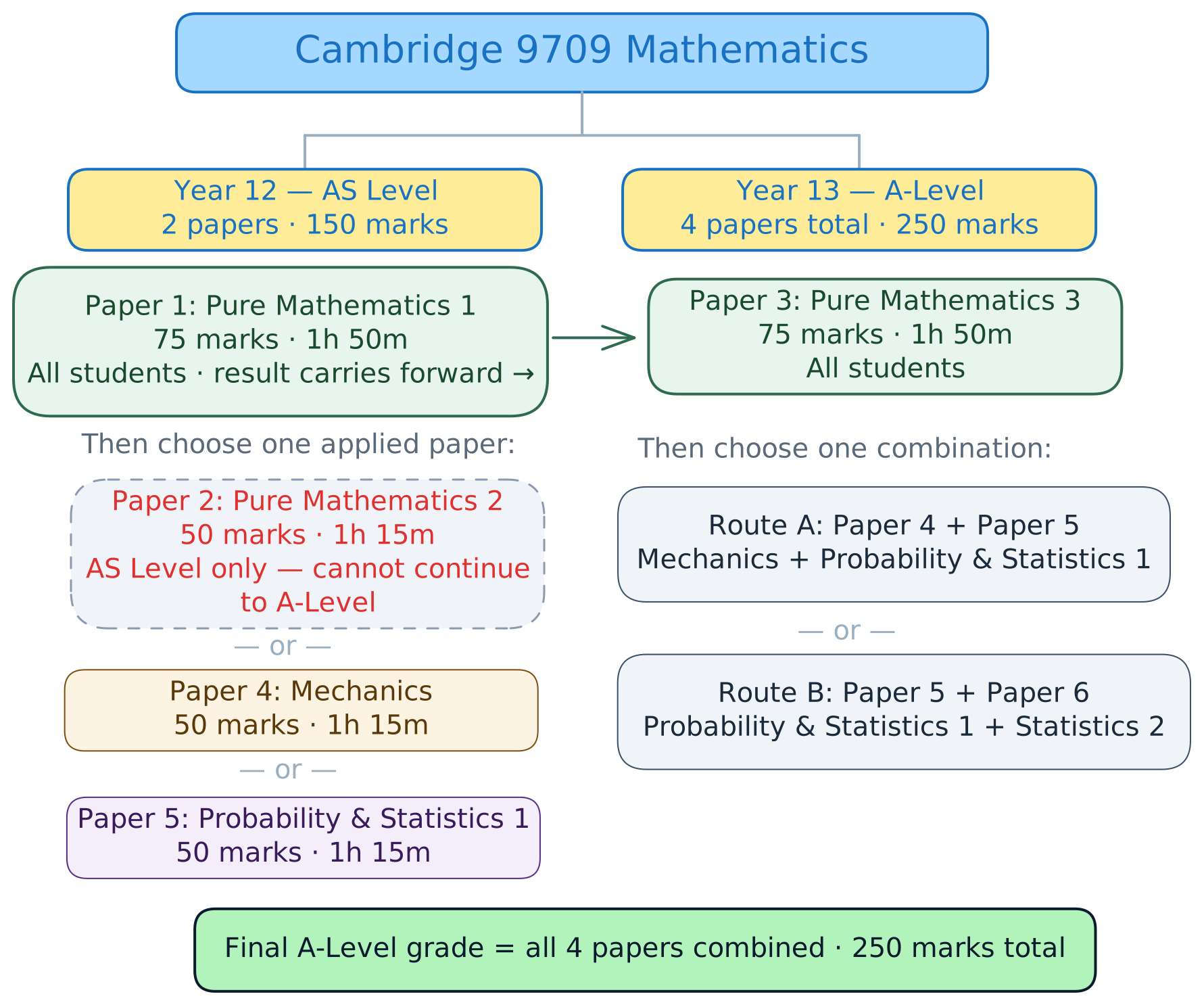
You sit 4 papers total. 2 in Year 12, 2 in Year 13. Pure Maths is in every route. The applied component (Mechanics or Statistics) depends on your school. Your overall grade is based on all 4 papers combined — not any single one.
Recent grade boundaries suggest that an A* often corresponds to a high aggregate score (frequently well above 80% overall), with A and B normally somewhat lower. Treat any numbers you see online as approximate only – boundaries change every session. Check Cambridge's published grade threshold tables for the most recent session.
How Cambridge Marks Your Paper (M, A, and B Marks)
M marks (Method) are awarded for using the correct mathematical approach, even if your final answer is wrong. If a question is worth 6 marks and 3 of them are M marks, you can earn those 3 marks simply by showing the right method – even if you make an arithmetic slip halfway through.
A marks (Accuracy) are awarded for correct results that follow from a correct method. A marks usually depend on the preceding M mark being earned: you need the method first, then the accurate execution of that method.
B marks (Independent) are awarded for specific correct statements or results, independent of method. These are standalone marks – you either state something correct (for example, a key formula or a particular value) or you do not.
Consider a 6‑mark integration question split, for example, into 3M + 2A + 1B. A student sets up the integral correctly (1M), applies a valid technique (1M), substitutes the limits correctly (1M), but makes a sign error when simplifying the final expression. In a typical mark scheme, she would still earn most or all of the M marks and may still gain the B mark for using the correct formula, even though the numerical answer is wrong. That could be 4 out of 6 – a strong result from a ‘wrong’ answer.
Now consider a student who skips straight to a final answer without showing any working. Even if the answer is correct, the examiner may have no basis to award the M marks, because the method is invisible. In many Cambridge pure mathematics questions, a correct answer with no working will therefore earn 0 or very few marks.
Show every step of your working. Method marks are your safety net, and they typically make up a large proportion of the marks on any given question.
Which Topics to Prioritise
There Is No Topic You Can Skip
Cambridge publishes weighting by paper and by assessment objective. It does not publish a topic breakdown for Pure 1, and it does not commit to one. Treat all eight topics as examinable in every session.
- Every topic in the Pure 1 subject content is examinable in every session.
- The mix moves between variants and between sessions.
- Betting on a topic not showing up is the single most expensive revision mistake in Pure 1.
That is why a "skip the small topics" strategy fails on this paper. You cannot know in advance which topics carry the weight in the paper you actually sit, so the whole subject content has to be secure.
The 80/20 Principle
Take a diagnostic past paper. Mark it using the official mark scheme. Then categorise every mark you lost by topic. Most students find that 70–80% of their lost marks cluster in two or three topics. Those are your priority topics. Spend 80% of your revision time on them. The natural instinct is to revise what you already know – it feels productive because you get the answers right. But that is revision theatre: it looks like hard work, yet it doesn’t move your marks. Real progress comes from sitting with the topics that make you uncomfortable.
The Revision Strategy That Actually Works
Phase 1 – Topic Mastery (Weeks 1-6)
One major topic per week. For each topic: read the revision notes to refresh the concepts, attempt 10-15 questions without looking at solutions, check your answers against the mark scheme, and for every question you got wrong, write down why you got it wrong (knowledge gap, careless error, or misread question). Re-attempt the ones you got wrong the next day. Research by Roediger and Butler (2011) found that retrieval practice – actively solving problems from memory rather than re-reading material – improves exam performance by two to three times compared to passive review.
At the end of each week, do a timed set of 10-15 questions on that topic. If you score below 70%, spend another two to three days on it before moving on.
Phase 2 – Past Papers (Weeks 7-10)
Shift from topical practice to full papers under exam conditions. Timed conditions: 1 hour 50 minutes for Pure papers, no interruptions. No notes or solutions open during the paper. Mark immediately after finishing, using the official mark scheme. Categorise every error: was it a knowledge gap, an execution error, or a question you misread?
Target five to eight full papers per component before the exam. Use both the Paper 12 and Paper 13 variants – they cover the same syllabus but with different questions, so you effectively double your past paper supply.
Phase 3 – Gap-Fill & Peak (Weeks 11-12)
By now you have data. Your past paper results will show you exactly which two or three topics still leak marks. In these final two weeks: do targeted topical questions on your remaining weak areas only – not full papers. Read the most recent examiner report (available free from Cambridge International and BestExamHelp) – it tells you exactly what students got wrong and why. Review your mistake log the night before the exam. Do not try to learn anything new in the final week. Consolidate what you know. Rest the night before.
Know exactly where to focus next
Most students revise by topic order or gut feel. ExamPilot tracks which areas you've genuinely mastered and surfaces the gaps that cost marks — so your revision time goes where it actually counts.
By joining, you agree to receive emails from ExamPilot. Unsubscribe any time.
Adapting the Plan for Less Time
8 Weeks Out
Compress Phase 1 to four weeks by covering two topics per week. Keep Phase 2 at three weeks and Phase 3 at one week. You will go faster but the structure holds.
4 Weeks Out
Skip Phase 1 entirely. Go straight to full past papers. Your first two papers are diagnostic – use them to identify your three weakest topics. Spend weeks 2 and 3 doing targeted topical practice on those areas only. Week 4 is two more full papers plus your mistake log review.
2 Weeks Out
Past papers only. One per day. After each paper, spend 30 minutes drilling the topic where you lost the most marks. Focus on technique: showing full working, finding all solutions in trigonometry questions, checking discriminant conditions in quadratics.
Best Resources for Cambridge 9709
| Resource | Type | Cost | Best For | Limitation |
|---|---|---|---|---|
| PapaCambridge | Past papers archive | Free | Complete past paper collection with mark schemes | No teaching content, just papers |
| BestExamHelp | Past papers + examiner reports | Free | Well-organised examiner report archive | No original analysis |
| Physics & Maths Tutor | Notes + past papers | Free | Cheat sheets and topic summaries | Covers both Cambridge and Edexcel; content depth varies by topic |
| ExamSolutions | Video explanations | Free | Step-by-step video walkthroughs on YouTube | Start-from-basics approach, can be slow |
| Save My Exams | Revision notes + questions | ~£60/year | CIE-specific structured notes | Paywalled |
| ExamPilot | Adaptive practice + AI coach | Waitlist | Exam Readiness Index, Ask Sparky, Smart Review | Coming soon |
The honest answer is that no single resource does everything. PapaCambridge and BestExamHelp are essential for past papers and examiner reports – every 9709 student should be using these. Physics & Maths Tutor has strong cheat sheets but is designed for UK boards, so the syllabus mapping is not exact for CIE. Save My Exams is currently one of the strongest paid options for Cambridge‑specific revision notes, at roughly £60 per year. ExamPilot fills the gap that static resources cannot: it adapts to your performance, tracks your accuracy by topic, and uses spaced repetition to resurface concepts you are starting to forget.
Exam Day Strategy
Before the Exam
Review your mistake log, not new content. You are not going to learn anything new in the last hour – but you can remind yourself of the errors you tend to make. Check your calculator is in the right mode. Degrees versus radians is the most common calculator-related mistake in 9709, and it costs full marks on affected questions. Read the rubric on the front page – it settles your nerves and reminds you of the rules.
During the Exam
Pacing: 75 marks in 110 minutes gives you approximately 1.5 minutes per mark. A 10‑mark question gets roughly 15 minutes. A 4‑mark question gets about 6 minutes. Use this as a rough guide – if you have spent more than the allocated time on a question and you are stuck, move on.
- Attempt EVERY question – partial marks are better than zero
- For 'show that' questions: show every step, don't jump from start to answer
- If stuck: move on after 3 minutes, come back at the end
- For trigonometry: always check 'how many solutions in the interval?'
Common Last-Minute Traps
How ExamPilot Helps You Pass 9709
Everything in this guide boils down to three things: know where the marks are, know where your gaps are, and close them systematically. ExamPilot is built to do exactly that. The Exam Readiness Index gives you a predicted grade updated in real time based on your actual practice performance – not a self-assessment, not a quiz score, but a statistically modelled prediction of your exam outcome. Topic-level gap identification breaks down your accuracy by topic and subtopic, so you can see at a glance that your integration is at 82% but your trigonometric identities are at 51%.
Ask Sparky (coming soon) is an AI coach available 24/7, designed for international students who cannot always access a teacher outside school hours. It does not give you the answer – it asks guiding questions until you reach the solution yourself. Smart Review is powered by the FSRS spaced repetition algorithm and resurfaces topics at the optimal moment before you forget them. ExamPilot is built specifically for Cambridge 9709.
Ready to know exactly where you stand?
ExamPilot identifies your weak spots across all Pure 1 topics and targets them with adaptive practice.
By joining, you agree to receive emails from ExamPilot. Unsubscribe any time.
Reviewed by
Teresa González is co-founder of ExamPilot, an adaptive learning platform for Cambridge and Edexcel A-Level students. She holds Law and Marketing degrees from ICADE, and an MBA from ICEX-CECO, Spain's leading international trade institution.
Her career spans international trade and investment across Spain, Nigeria, and the United Kingdom. She subsequently became an entrepreneur and trading coach and educator at an internationally recognised trading education firm, before co-founding ExamPilot.
Her direct experience with A-Level preparation comes from supporting her children through the Edexcel and Cambridge examination systems. At ExamPilot, she leads educational content strategy, syllabus alignment, and quality review.
How to Pass Cambridge 9709: The Complete Exam Strategy Guide: frequently asked questions
It is a significant step up from IGCSE Mathematics. The content is deeper, the questions are longer, and the mark schemes demand precision. That said, structured revision makes A and A* achievable for students who are willing to put in consistent, targeted practice. The difficulty is in applying concepts under exam conditions, not the concepts themselves.
For a single component (e.g. Pure 1 only), aim for five to six hours per week of active practice -- not passive reading, but actually solving problems. If you are preparing for all three A-Level components simultaneously, budget 12-15 hours per week. Quality matters more than quantity, but you do need the volume to build fluency.
It is possible if you have a strong foundation from classwork throughout the year, but it is risky. With four weeks, skip topic-by-topic revision and go straight to past papers. Use the first two papers as diagnostics, then spend your remaining time drilling the three weakest topics. Focus on exam technique -- showing working, managing time, attempting every question.
Topics first, then past papers. Doing past papers without topic mastery is diagnostic, not practice -- you will identify gaps but you will not fill them. Build your topic knowledge in Phase 1, then use past papers in Phase 2 to train exam technique and identify remaining weaknesses.
AS Level Mathematics consists of two papers (150 marks total). The available routes are: A) Paper 1 (Pure Mathematics 1) + Paper 2 (Pure Mathematics 2) – Pure only. This route is AS‑only and cannot be carried forward to complete the A Level. B) Paper 1 (Pure Mathematics 1) + Paper 4 (Mechanics) C) Paper 1 (Pure Mathematics 1) + Paper 5 (Probability & Statistics 1) A Level Mathematics consists of four papers (250 marks total). All A‑Level candidates take Paper 1 (Pure Mathematics 1) and Paper 3 (Pure Mathematics 3), plus either Paper 4 (Mechanics) and Paper 5 (Probability & Statistics 1), or Paper 5 and Paper 6 (Probability & Statistics 2). AS can be taken as a standalone qualification or as the first half of the full A Level, depending on the route.
PapaCambridge and BestExamHelp both host extensive archives of Cambridge 9709 past papers, mark schemes, and examiner reports. The Cambridge International website also provides recent papers.
Grade boundaries vary by session and depend on paper difficulty, so there is no fixed ‘A* mark’. In recent series, A* has often corresponded to a high overall score (frequently well above 80% across all four A‑Level papers), but the exact boundary changes every year. As a working target, aim to score consistently above about 75–80% on practice papers to give yourself a comfortable margin.